10 Business Decisions You Should Always Ask AI About Before Acting
BUSINESS
Asking AI Team
6/30/2026


Most business owners make their biggest calls the same way: gut feeling, a few conversations, maybe a quick Google search. Sometimes that works. Often, it leaves money on the table — or creates problems that take months to fix.
AI won't replace your judgment. But it can pressure-test it before you act. The business decisions you should ask AI about are often the ones that feel straightforward — hiring, pricing, launching a new product — where unchecked assumptions quietly drive the outcome.
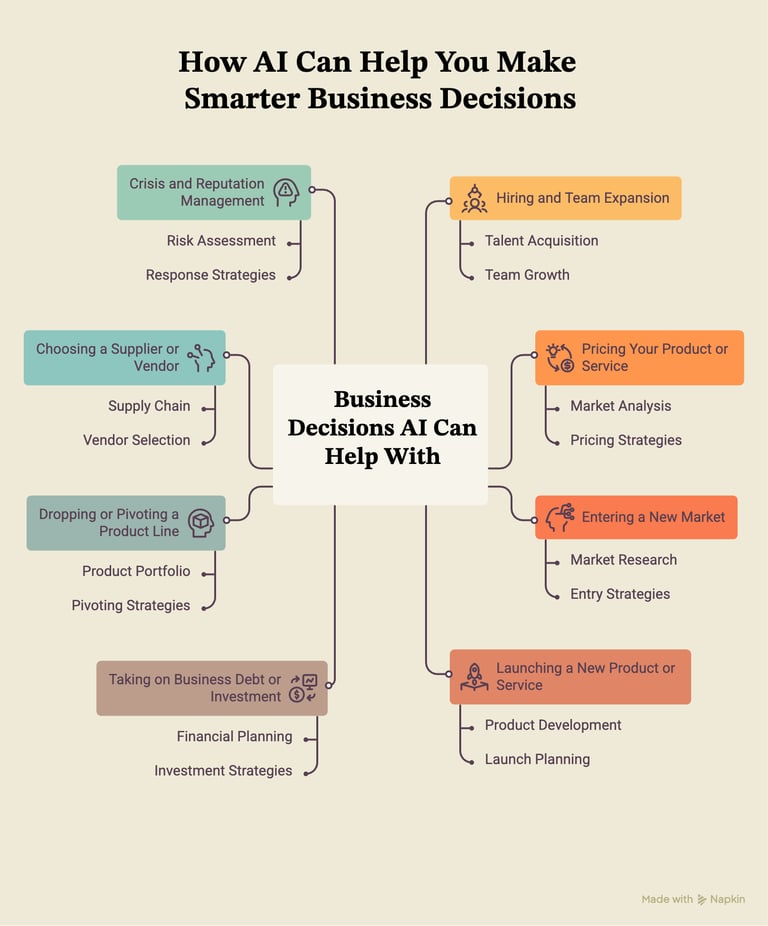
This article walks through 10 decision types where running things past an AI tool first can save you time, money, and a fair amount of regret. Each one comes with practical guidance on how to approach it.
1. Hiring and Team Expansion
Hiring a new team member is an exciting milestone, but finding the right fit is crucial. In fact, Humani HR points out that "Replacing an employee can cost anywhere from 50% to 200% of that employee’s annual salary depending on the role and experience level." Between onboarding, training, and the disruption of a bad match, a hiring mistake can really set you back.
Before you publish a job post, you can use AI to think through the structure of the role. Start with the basics: is it best to bring on a full-time hire, a part-time teammate, or a freelancer? The right choice depends on your budget, workload, and whether you need deep company knowledge or a specific, short-term skill set.AI can help you map out the cost implications of each option side-by-side, identify role requirements you may have missed, and flag risks you haven't considered — like whether the role overlaps with existing responsibilities.
Once you've decided to hire, AI is genuinely useful for drafting job descriptions that attract the right candidates rather than a high volume of wrong ones. It can also help you build structured interview frameworks, so you're evaluating candidates consistently rather than going with whoever gave the best first impression.
2. Pricing Your Product or Service
Pricing decisions tend to carry a lot of emotional weight. Founders often price too low because they're worried about scaring off customers — or too high because they've anchored their price to the effort it took to build the thing. Neither approach is grounded in how your market actually works.
AI is a useful thinking partner for removing that emotional bias from the process. Feed it information about your target customer, your competitors, and your cost structure, and ask it to model out different pricing tiers. What happens to your margins at each tier? Where are the psychological price points that might increase or decrease conversion? What objections is each price point likely to trigger?
You can also use AI to stress-test your pricing against competitive positioning. If a lower-cost competitor exists, what's your argument for the price difference? If you're the most affordable option, does that signal quality concerns to your buyer?
The goal isn't to have AI set your price. It's to arrive at your price with a clearer rationale — one you can defend to a customer, a partner, or an investor.
3. Entering a New Market
Asking AI for business advice on market expansion is one of the smartest moves you can make before you start spending. Whether you're thinking about entering a new geographic market, reaching a new customer segment, or launching a new product line, the same truth applies: the decision looks easier from the outside than it actually is once you're in the thick of it.
Use AI to build a working map of the market before you commit resources. A structured prompt might look like this: "I run a [type of business] currently serving [current market]. I'm considering expanding into [new market]. What does the competitive landscape look like? What are the main entry barriers? What do companies that have succeeded in this market have in common?"
That kind of analysis gives you a foundation for the real questions: Is the market large enough to justify the investment? What's the likely timeline to profitability? Are there regulatory or logistical factors you haven't accounted for?
AI can also help you think through timing. A market that looks attractive today might be facing headwinds — shifts in consumer behavior, incoming competitors, or regulatory changes — that change the picture significantly. Surfacing those factors early is far less costly than discovering them after you've expanded.
4. Launching a New Product or Service
The enthusiasm around a new idea is often at its highest right before the launch decision is made. That's exactly when clear-headed analysis matters most.
Before investing in development, marketing, or inventory, use AI to validate the idea from multiple angles. Start with the value proposition: who specifically is this for, what problem does it solve, and why would they choose it over what already exists? Ask AI to challenge that framing directly — not to agree with you, but to find the gaps.
From there, work through the go-to-market questions. What channels will you use to reach your target customer? What does the competitive set look like? What's a realistic customer acquisition cost? AI can help you build out a basic launch framework that covers positioning, pricing, channel strategy, and a timeline.
One of the most useful things AI can do here is stress-test your assumptions. If your business case depends on capturing 5% of a market within 12 months, ask AI to identify what would need to be true for that to happen — and what the most common failure points look like for similar launches. You may still proceed. But you'll do it with your eyes open.
5. Taking on Business Debt or Investment
Financial decisions deserve extra care. AI can help you think through the options and model different scenarios — but any decision involving significant debt or equity should be reviewed by a qualified accountant or financial advisor before you commit. Consider AI a starting point here, not a final word.
That said, the starting point matters. According to the Federal Reserve's 2024 Small Business Credit Survey, 39% of small employer firms carried more than $100,000 in outstanding debt — a share that remains higher than pre-pandemic levels. Among firms that were denied financing, 41% were told they had too much existing debt, compared to just 22% in 2021. These numbers suggest that many business owners are taking on debt without a complete picture of how it affects their creditworthiness down the line.
AI can help you model repayment scenarios before you sign anything. What does this loan look like at 6%, 9%, and 12% interest? How does it affect your cash flow if revenue comes in 20% below projections? If you're reviewing investor terms or a credit facility, ask AI to walk through the key clauses and flag anything that warrants closer attention from your legal or financial team.
Making business decisions with AI around financing isn't about replacing professional advice — it's about walking into those conversations better prepared.
6. Dropping or Pivoting a Product Line
Knowing when to cut something is harder than deciding what to launch. There's usually history attached, and often a segment of customers who genuinely use the product. That makes it easy to keep carrying something that's quietly draining resources.
AI can help you approach this with more clarity. Share the performance data you have — revenue trends, margin, customer feedback, support volume — and ask AI to identify patterns. Is the product declining because of execution issues, or is the market itself shifting? Are there segments of customers where it still performs well, even if the overall numbers are weak?
As the saying goes, AI predictive maintenance programs can achieve up to 10 times ROI over a few years. This can be game-changing when you're weighing whether to keep, pivot, or phase out a product line.
The opportunity cost question is equally worth examining. What would happen if you redirected the time, budget, and attention currently going into this product line toward something else? AI can help you think through what that reallocation might look like, and whether the numbers support a full cut, a pivot, or a refocus on the most profitable segment.
7. Choosing a Supplier or Vendor
Vendor selection looks straightforward until you're 18 months into a bad contract. The real cost of a poor vendor relationship — missed deadlines, quality inconsistencies, poor communication, inflexible terms — rarely shows up in the initial pitch.
Use AI to build a structured evaluation framework before you start talking to suppliers. What are your non-negotiables? What are the terms you want to push back on? What questions should you ask that most vendors won't volunteer the answers to?
AI can also help you draft an RFQ (request for quotation) that gives you comparable responses from multiple vendors, rather than pitches designed to make apples-to-apples comparison difficult. Once you have responses in hand, AI can help you identify which clauses in a contract warrant legal review — liability caps, termination conditions, exclusivity provisions, and payment terms chief among them.
8. Crisis and Reputation Management
When something goes wrong publicly — a wave of negative reviews, a product failure, a complaint that starts gaining traction — the instinct is often to respond fast. That instinct isn't wrong, but the response matters more than the speed.
Crisis and reputation management is one of the business decisions you should ask AI about before you hit send on anything. A poorly worded response can make a bad situation significantly worse. AI can help you draft multiple versions of a response, each calibrated for a different tone and audience — measured and factual, empathetic, more direct — so you can see your options before committing to one.
Beyond the immediate response, AI can help you map out a communication plan. Who needs to be informed, and in what order? If the issue involves a product or service failure, what's the remediation message to affected customers? What do you say publicly versus what you handle privately?
It's also worth asking AI to stress-test your messaging before it goes out. Share your draft and ask: "What assumptions does this response make that might not hold? How could a critical reader interpret this negatively?" That kind of pre-mortem on your communication can prevent a second wave of fallout.
9. Marketing Strategy and Budget Allocation
Marketing budgets are easy to spend and hard to evaluate. The combination of multiple channels, attribution complexity, and a long feedback loop means that many business owners don't find out a strategy isn't working until they've spent months on it.
AI can help you think through channel options before you allocate a dollar. Given your target customer, what channels are most likely to reach them at the point of decision? What does a realistic customer acquisition cost look like across those channels? What's the minimum viable budget to actually test one channel properly, rather than spreading thin across several?
On the creative side, AI is useful for generating campaign concepts, testing different messaging angles, and identifying which value propositions are likely to resonate with different audience segments. You can also use it to reverse-engineer what's working for competitors — not to copy it, but to understand the strategic logic behind their approach.
Budget allocation, in particular, benefits from scenario modeling. Ask AI to walk through what a 60/30/10 split across your top channels might look like versus a more concentrated approach. What are the risks and advantages of each?
10. Business Exit, Sale, or Succession Planning
Exit planning sits in the category of decisions that business owners consistently delay until the stakes are too high to think clearly. According to the Exit Planning Institute's 2023 National State of Owner Readiness survey, nearly half (49%) of business owners plan to exit within five years — yet in a 2024 Gallup survey, one-third admitted they had no long-term plan or were uncertain what would happen to their business after they left.
This is an area where AI can help you get organized before you involve advisors — and consulting AI for business exit decisions is a practical way to arrive at those conversations better prepared. AI can walk you through the key considerations: business valuation methods, the factors that affect what a buyer will pay, the difference between an asset sale and a stock sale, and how to structure an owner-dependent business to be more attractive to a buyer or successor.
Use AI to generate a list of questions to ask a business broker, M&A attorney, or financial planner before your first meeting. What does your business need to look like in three years to be positioned for the outcome you want? What documentation should you start building now?
One important caveat: exit planning involves significant legal and financial decisions. AI can help you frame the right questions and understand your options, but a qualified attorney and accountant need to be involved in any actual transaction.
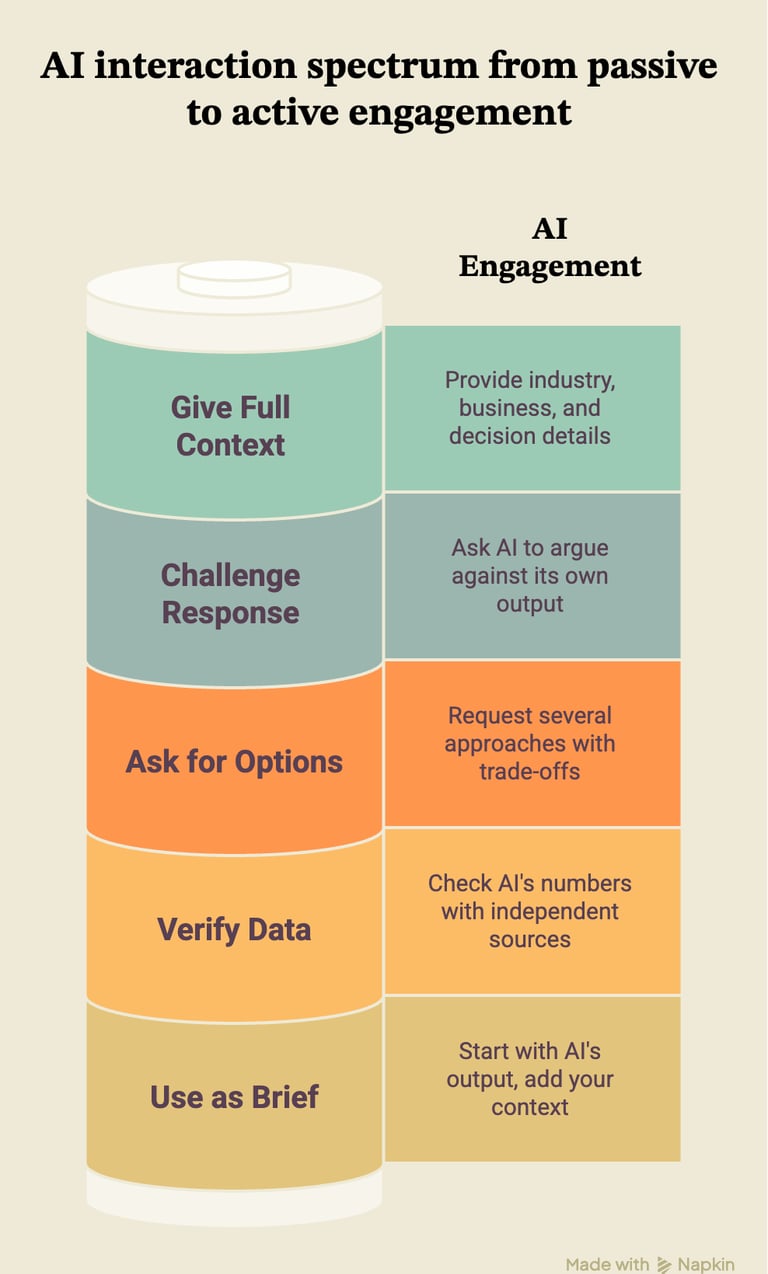
Bonus Tip:
How to Ask AI the Right Way
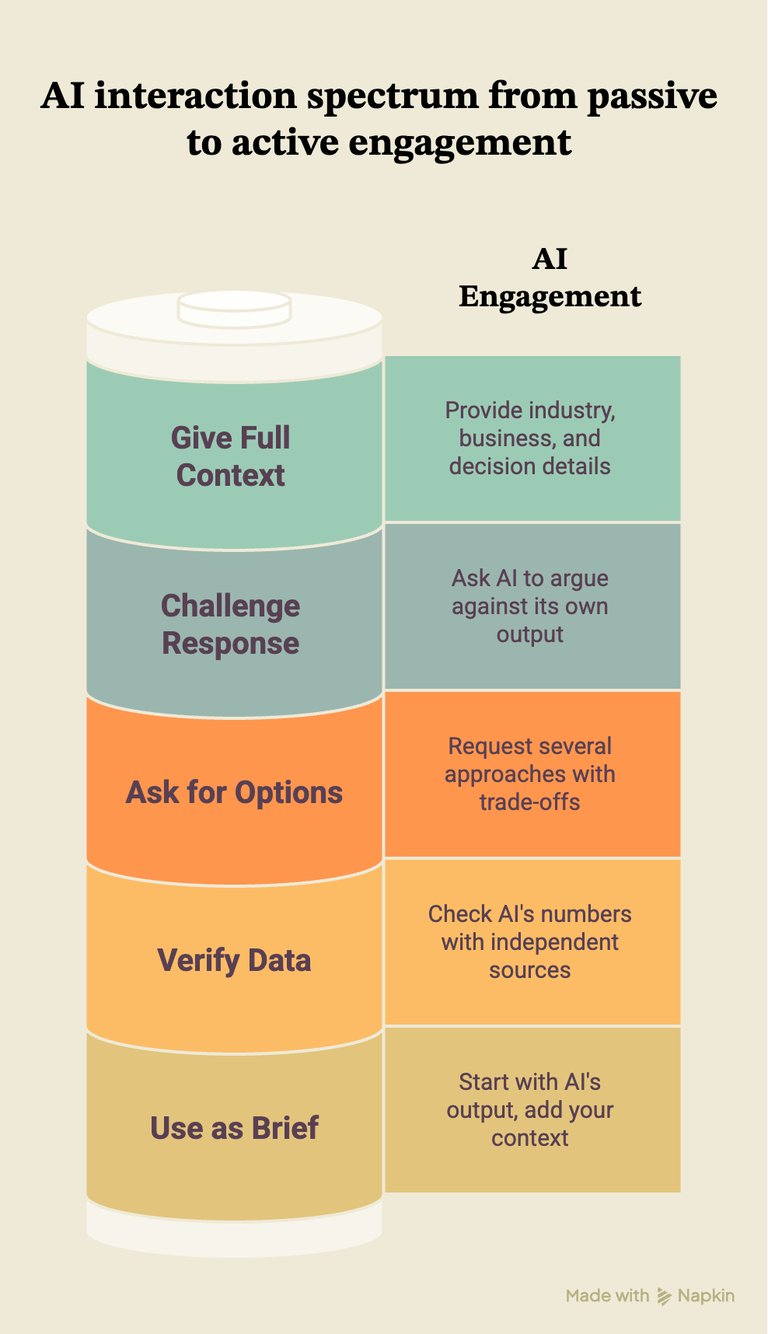
Getting useful output from AI requires giving it enough to work with. Here's a simple framework:
Give full context. Share the specifics — your industry, business size, the decision you're facing, any constraints. Generic prompts produce generic answers.
Ask for multiple options. Rather than asking AI to recommend a single course of action, ask it to outline two or three approaches with their respective trade-offs.
Challenge the first response. If the output seems too neat, ask AI to argue the other side. "What's the strongest case against this approach?" is often the most useful follow-up.
Verify data independently. AI can make factual errors, particularly with recent statistics. Treat any numbers it provides as a starting point for verification, not a citation.
Use the output as a brief. Think of AI's response as a first draft to work from, not a final answer. Your judgment — informed by context AI doesn't have — is what makes the decision yours.
Make the Decision First; Get AI in the Room Earlier
There's a habit worth building: before you commit to any significant business decision, spend 20 minutes asking AI about it first. Not because it'll make the decision for you, but because it tends to surface the questions you haven't asked yet.
Making business decisions with AI isn't about replacing experience or professional advice. It's about arriving at those conversations — with your accountant, your attorney, your board — having already thought through the structure of the problem. That tends to produce better decisions, faster.
If you want to put this into practice, try Asking AI about the next big decision on your list. You might be surprised what comes up.
Business Decisions You Should Ask AI About FAQs
Can AI replace professional advisors like accountants or lawyers?
No. AI is a useful thinking and planning tool, but it doesn't carry professional liability, doesn't have access to your full financial or legal picture, and can make errors. For decisions involving significant money, legal structure, or regulatory compliance, always involve qualified professionals.How accurate is AI when it comes to business strategy?
AI is generally strong on frameworks, scenario modeling, and generating options. It's less reliable on current market data, specific regulations, or highly localized information. Treat its output as a structured starting point, and verify anything factual before acting on it.Does AI understand my specific industry?
The more context you give it, the better. Share details about your industry, customer base, geography, and competitive environment. Without that context, AI defaults to general advice that may not apply to your situation.What AI tools are best for business decisions?
Several capable tools exist — ChatGPT, Claude, Gemini, and others. The best tool is the one you'll actually use consistently. Most have free tiers that are sufficient for the decision-support tasks described in this article.When should I involve a human expert instead of AI?
Any time real money, legal liability, or binding agreements are on the line. AI is a planning and thinking tool. Execution — especially in financial, legal, or regulatory contexts — requires human expertise and accountability.How do I know if AI's advice is actually good?
Ask it to show its reasoning, challenge its own recommendations, and flag where its confidence is lower. Good AI output includes caveats. If a response sounds too definitive on a complex topic, that's worth questioning.