8 Real Cases for Free AI Medical Advice (And Where It Stops Being Enough)
MEDICAL
Jill Sendoor
7/6/20267 min read


TL;DR: Free AI medical advice earns its place in symptom triage, medication questions, doctor-visit prep, and decoding lab results — not in diagnosing or managing anything urgent. It won't replace a doctor, but it fills the gap between appointments with fast, clear answers when a full visit isn't necessary. Knowing exactly when to hand off to a real professional is the part that matters most.
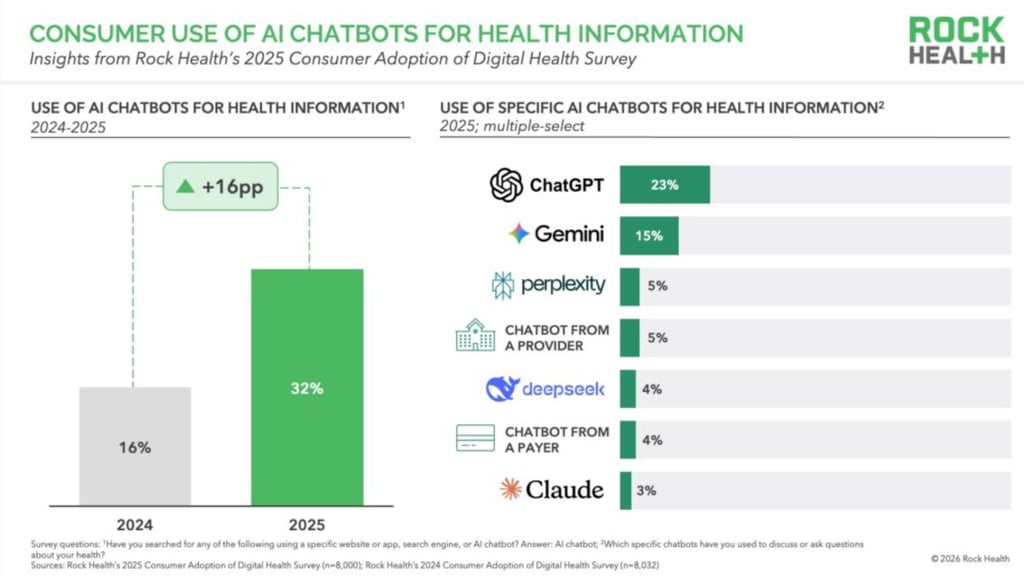
Healthcare has always been full of small, nagging questions: Is this rash normal? Can I take these two medications together? Should I be worried about this ache, or can it wait until Monday? For years, the only options were a rushed doctor's visit, a worrying scroll through search results, or simply ignoring the question altogether — hoping it resolves on its own. Free AI medical advice has quietly become a fourth option, and the shift toward it has been fast. According to Rock Health's 11th annual Consumer Adoption of Digital Health Survey, the share of U.S. adults using AI chatbots for health questions doubled in a single year, from 16% to 32%. That's not a niche behavior anymore — it's becoming a default first step for a meaningful share of the population.
This isn't about replacing doctors, and no serious AI health tool claims to. It's about the dozens of small moments between appointments where a clear, well-organized answer is genuinely useful — moments that used to mean either an unnecessary trip to urgent care or living with an unanswered question for weeks. Below are the most practical cases for free AI medical advice, along with where the technology earns its keep, and where it clearly doesn't.
Triaging a New Symptom Before You Decide What to Do
The most common entry point into AI health tools is symptom triage. Someone has a headache, a stomach ache, or a strange new pain, and what they actually want isn't a diagnosis — it's a starting point. Is this likely minor, or does it warrant a same-day appointment? Should it be watched for a day or two, or addressed now? A good AI health assistant can walk through the relevant follow-up questions — duration, severity, associated symptoms, anything that's changed recently — and return a structured, readable summary of possibilities and next steps. It functions less like a diagnosis and more like a well-organized first pass that helps someone decide what to do next, rather than leaving them to guess. Platforms like Asking AI are built around exactly this kind of structured triage conversation, rather than a generic wall of search results pulled from unrelated forums and old articles.
A typical triage exchange usually moves through the same few checkpoints, whether the tool is built specifically for health or is a general-purpose assistant:
Describe the symptom — what it is, where it is, and how long it's lasted.
Add context — severity, what makes it better or worse, and anything unusual happening alongside it.
Get a structured read — likely low-concern explanations versus red flags worth acting on.
Decide next steps — self-care at home, a routine appointment, or urgent care.
That structure alone is often the value: turning a vague worry into a concrete decision.
A. Getting Straight Answers to General Health Questions
Not every health question is urgent, and plenty aren't really about a specific symptom at all — they're just confusing. What actually causes a migraine? Why do allergies seem to get worse some years and not others? What's the real difference between a cold and the flu, beyond "one's worse"? These are the kinds of questions people used to type into a search engine and then wade through ads, outdated blog posts, and conflicting forum opinions to answer, often ending up more confused than when they started. An AI assistant can synthesize a direct, current, well-organized answer in seconds, at whatever level of detail the person actually wants — a quick summary for some, a deeper explanation for others.
B. Checking Medications, Interactions, and Side Effects with AI
Medication questions are a particularly strong use case for AI medical advice, because they tend to be narrow, factual, and time-sensitive — exactly the kind of question AI handles well, and exactly the kind that's easy to put off asking a real person. It's a bigger use case than it might seem at first glance: a recent West Health-Gallup survey found that 46% of recent AI health users had used it specifically to understand medication side effects, putting it among the most common reasons people turn to these tools at all. Common questions in this category include:
Can this medication be taken on an empty stomach, or does it need food?
Does it interact with something else already being taken, including over-the-counter supplements?
What's a normal, expected side effect versus one worth calling a pharmacist about immediately?
Is there a lower-cost or generic equivalent worth asking about?
A pharmacist remains the authority for anything serious or dosage-related, but AI tools are genuinely useful for the smaller clarifying questions that don't always feel like they justify a phone call — the ones that would otherwise just go unanswered.
C. Preparing for a Doctor's Visit with Better Questions
One of the most underrated uses of AI health tools is visit preparation, and it's arguably where the return on a few minutes of effort is highest. People often walk into appointments having forgotten half of what they meant to ask, or unsure how to describe a symptom clearly and concisely under time pressure. An AI assistant can help organize a timeline of symptoms, draft a prioritized list of questions, and even suggest what information a doctor is likely to ask for — turning a rushed, ten-minute appointment into a genuinely more productive conversation, rather than one spent trying to remember what mattered in the first place.
D. Translating Lab Results and Medical Jargon into Plain English
Lab results and after-visit summaries are notoriously hard to parse for anyone without a clinical background. Reference ranges, abbreviations, and clinical shorthand aren't written for patients — they're written for other clinicians communicating efficiently with each other. AI tools are well-suited to translating this language into something understandable: what a slightly elevated marker might mean in context, what falls within normal variation, and what's genuinely worth flagging to a doctor versus what's likely noise. This doesn't replace a physician's interpretation of the full clinical picture, but it meaningfully closes the gap between receiving a result full of unfamiliar numbers and actually understanding what it says about your health.
E. Everyday Wellness and Lifestyle Guidance
Not every health question is about illness at all. A large share of AI health conversations are about sleep quality, nutrition, exercise recovery, stress management, or general wellness habits — questions that are low-stakes but still meaningfully affect quality of life. These are exactly the kind of questions where AI can offer well-reasoned, evidence-informed suggestions without the friction of booking an appointment for something that clearly isn't urgent, but is still worth getting a thoughtful answer to.
F. Managing a Chronic Condition Between Checkups
For people managing conditions like diabetes, hypertension, or chronic pain, day-to-day questions come up constantly — far more often than scheduled checkups allow for, and often at inconvenient times. AI tools can help track patterns over time, explain how lifestyle factors interact with a given condition, and flag when something described sounds like it warrants earlier medical attention rather than waiting for the next appointment. It's worth noting this mirrors a broader shift happening across professional services generally, not just medicine — a similar dynamic is playing out in how AI vs lawyers is reshaping expectations around fast, everyday access to expert-adjacent guidance, in law as much as in healthcare.
G. Knowing Where Free AI Medical Advice Stops and a Doctor Should Start
This is arguably the most important use case on this list: helping people recognize when a question has moved beyond what AI should be answering at all. Severe, sudden, or worsening symptoms; anything involving chest pain, difficulty breathing, or signs of stroke; and any situation requiring a physical exam, imaging, or bloodwork all belong with a licensed medical professional, not a chatbot — no matter how well-designed. A responsible AI tool should say so clearly and immediately rather than attempt to answer everything it's asked. The table below is a rough, practical guide to where the line tends to sit:
For a closer look at exactly where the line sits and why, see Free AI Medical Advice — what you can and can't reasonably rely on.
The Bottom Line on Free AI Medical Advice
Free AI medical advice isn't trying to replace a doctor, and treating it that way is the one real risk here. What it's actually good at is filling the space around the doctor's visit: the questions before, the confusion after, and the everyday uncertainty in between that never quite justified a full appointment but still deserved a real answer. Used with that framing — as a fast, well-informed starting point rather than a final word — it's one of the more genuinely useful applications of AI available today.
Top Cases for Free AI Medical Advice: FAQs
Is free AI medical advice actually accurate?
It's generally reliable for well-established, factual health information, but accuracy depends on the specific tool and how specific the question is. It should never be treated as the final word for diagnosis or treatment.Can AI replace a doctor for serious symptoms?
No. AI tools are best used for triage, education, and preparation — not for diagnosing or managing anything urgent or severe, which requires a licensed professional's judgment.Is it safe to ask AI about medication interactions?
It's a reasonable starting point for general questions, but always confirm anything medication-related with a pharmacist or doctor, especially around existing prescriptions or dosage changes.Why is free AI medical advice becoming so popular?
It's fast, available anytime, and removes the friction of booking an appointment for questions that don't need one — while a well-designed tool still points people toward professional care when it actually matters.
Do I need an account to use an AI medical advice tool?
This varies by platform. Many offer free, no-signup access for basic questions, with additional features available to registered users.Why is free AI medical advice becoming so popular?
It's fast, available anytime, and removes the friction of booking an appointment for questions that don't need one — while a well-designed tool still points people toward professional care when it actually matters.Do I need an account to use an AI medical advice tool?
This varies by platform. Many offer free, no-signup access for basic questions, with additional features available to registered users.