Asking AI for Medical Advice: What You Can and Can't Rely On
MEDICAL
Asking AI Team
6/22/20268 min read


It’s late at night. You notice a strange pain that wasn’t there earlier, a headache that won’t go away, or symptoms you can’t quite explain. The clinic is closed, your doctor isn’t available, and naturally, your mind starts racing. Instead of endlessly searching random websites, more people are now opening an AI chat and describing their symptoms directly.
You’re definitely not alone. According to an FKK poll, 1 in 3 adults now turn to AI chatbots for health information. Around 29% of people used AI tools for physical health questions in the past year, while 16% asked AI about mental health concerns. Asking AI for free medical advice has quickly become one of the most common uses for tools like ChatGPT and Claude because the experience is instant, accessible, and often easier to understand than traditional medical articles.
Still, AI is not a doctor — and knowing where it helps and where it falls short matters. In this guide, we’ll explore what free AI medical advice can genuinely support, the risks and limitations to keep in mind, and how to use these tools responsibly to make smarter healthcare decisions.
Why People Are Asking AI for Medical Advice
Healthcare isn't always easy to reach. Appointments can take weeks to book, urgent care visits cost money, and worries have a habit of showing up after hours when no one's available to answer. That gap between "I have a question now" and "I can see someone next Thursday" is exactly where AI has stepped in.
For years, people have typed their symptoms into search engines. You know the cycle: you look up a mild headache and somehow end up convinced it's something serious. Those panic-spirals were practically a rite of passage. AI changed the experience. Instead of a wall of scary links, you get a calm, conversational explanation that responds to your actual situation.
That difference matters. A chatbot can ask follow-up questions, clarify confusing terms, and walk you through possibilities without the dramatic worst-case framing. It feels more like talking to a knowledgeable friend than scrolling through a forum at 2am.
There's also the comfort factor. Plenty of people hesitate to "bother" a doctor with something that feels small. Asking AI feels low-pressure. You can ask the basic question, the slightly embarrassing one, or the "is this normal?" one without feeling self-conscious. That ease is a big reason the habit has caught on so quickly.
What AI Medical Advice Actually Gets Right
Here's the encouraging part: AI is genuinely useful for a lot of health-related tasks. When you use it for the right things, it can save you time, calm your nerves, and help you walk into appointments better prepared.
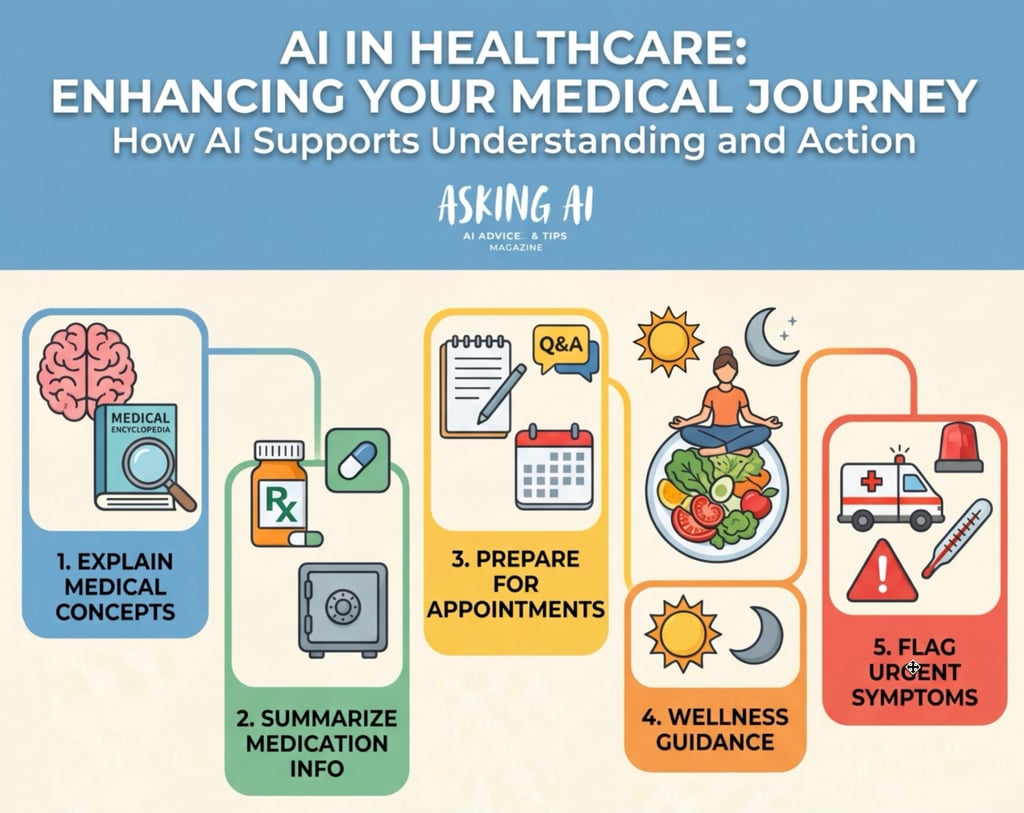
AI shines at translating complicated medical language into plain English. If a lab result, a diagnosis, or a doctor's note left you confused, AI can break it down clearly. It's also great at summarizing common medication side effects and explaining how certain drugs might interact, so you know what questions to raise with a pharmacist or physician.
It's a fantastic prep tool, too. Before an appointment, you can ask AI to help you organize your symptoms and write down the questions you want to remember. That way you make the most of your limited time with a doctor. And for general wellness: sleep habits, balanced nutrition, stress management, basic mental health tips, AI offers sensible, well-rounded guidance.
When asking AI for free medical advice, it can also recognize when something might need urgent attention and tell you clearly to seek care. That nudge can be genuinely valuable.
AI does this well:
Explains diagnoses, conditions, and medical terms in plain language
Summarizes common medication side effects and possible interactions
Helps you prepare questions before a doctor's appointment
Offers general wellness guidance on sleep, nutrition, and mental health basics
Flags when symptoms might warrant urgent or emergency care
Think of these as the tasks where AI truly earns its keep - information, organization, and clarity.
TL;DR: AI tools are becoming a go-to resource for health questions, but knowing when to trust them and when to call a doctor can make all the difference. This article breaks down exactly what AI does well, where it falls short, and how to use it safely for medical guidance.
Pick the tool that matches your goal. For understanding and prep, the general chatbots work well. For a structured symptom walk-through, the purpose-built options are worth a look.
The Future of AI in Healthcare - Where This Is All Heading
The AI you chat with today is just the consumer side of a much bigger picture. Behind the scenes, medical-grade AI is already supporting clinicians - helping read scans, flag patterns in data, and speed up research. That clinical AI is tested, regulated, and used alongside trained professionals, which makes it very different from a general chatbot.
The gap between those two worlds matters. Consumer tools are built for broad helpfulness, not medical certification. Medical-grade systems go through rigorous validation and oversight. As the technology grows, expect clearer regulation and accountability standards for any AI that touches health, so people know what they can safely rely on.
The most likely future isn't AI replacing doctors. It's AI working as a complement - handling explanations, prep, and routine questions so professionals can focus their time and expertise where it's needed most. Used that way, AI makes healthcare more accessible without removing the human judgment at its heart.
Conclusion
AI has earned a real place in how we approach our health. It can calm a late-night worry, explain a confusing diagnosis, and help you walk into an appointment ready and informed. That's genuinely useful, and it's worth embracing with confidence.
Just keep the boundaries clear. AI is a powerful first step, not a final answer. It informs, organizes, and explains, but it doesn't diagnose, prescribe, or replace the trained professional who knows your full story. Use it within those limits and you get the best of both worlds.
So go ahead and bookmark a reliable AI tool or two for those moments when you just need clarity. Then keep your doctor's number handy for everything else. Smart health decisions come from using both well.
The Real Limits - What You Should Never Rely on AI For
Now for the honest part. As helpful as AI can be, it has firm limits, and crossing them can be risky. The trouble is that AI sounds confident even when it shouldn't be relied on, so it's worth knowing exactly where the line sits.
AI cannot diagnose you. It can suggest possibilities based on what you describe, but it can never confirm a condition. A real diagnosis often needs a physical exam, lab tests, imaging, and the trained judgment of someone who can actually see and examine you. AI is working only from the words you type.
It also shouldn't guide your prescriptions. Adjusting a dose, starting a new medication, or stopping one are decisions that belong to a licensed professional who knows your full history. Getting this wrong can be genuinely dangerous.
Emergencies are another hard stop. AI can't call for help, can't assess severity in real time, and can't physically be there. If something feels serious, that's a moment for emergency services, not a chat window. Rare or complex conditions fall outside its reach too, since they usually require hands-on examination and testing that no chatbot can perform.
Mental health deserves special care. AI can be a supportive, comforting presence, but it is not a substitute for clinical treatment. In a crisis, you need a trained human and proper care.
Finally, there's the accountability gap. A licensed doctor carries professional responsibility for the advice they give. AI carries none. If it's wrong, there's no one accountable in the way there would be with a physician.
Never ask AI instead of a doctor for:
A confirmed diagnosis of a specific condition
Starting, stopping, or adjusting any medication
Emergency or rapidly worsening symptoms
Rare or complex conditions needing exams and lab work
Mental health crises or thoughts of self-harm
When any of these come up, close the chat and reach a real professional.
How to Ask AI for Medical Advice the Right Way
Used thoughtfully, AI becomes a much safer and more useful tool. The trick is in how you ask. A few small adjustments lead to clearer, more reliable answers.
Start by being specific. Vague questions get vague replies. Share your symptoms, how long they've lasted, how severe they feel, and any relevant background like existing conditions or medications. The more context you give, the more useful the response.
Next, frame your questions around understanding rather than diagnosis. Instead of "Do I have X?", ask "What could cause X?" That shift keeps AI in its lane — explaining possibilities — rather than pretending to confirm something it can't. Then treat whatever you learn as research, not a verdict.
Always cross-reference. If AI mentions a condition or treatment, check it against trusted sources like the NHS, Mayo Clinic, or the World Health Organization. Reliable institutions give you a solid second layer of confirmation before you act on anything.
Here are a few prompt examples that lead to safer, better answers:
"I've had a sore throat and mild fever for three days. What are some common causes, and when should I see a doctor?"
"Can you explain what this diagnosis means in simple terms, and what questions I should ask my physician?"
"What are the typical side effects of this medication, and what should I watch for?"
"Help me write down my symptoms clearly so I can describe them at my appointment."
Notice the pattern: you're asking AI to inform and organize, then bringing the results to a professional for the final word.
The Best Free AI Tools for Health Questions in 2026
Not every AI tool handles health questions the same way. Some are broad generalists, while others are built specifically for symptom checking. Here's a quick look at the most popular free options and what each does best.
General chatbots like ChatGPT, Claude, and Gemini are versatile and excellent at explaining conditions, summarizing information, and helping you prepare for appointments. Purpose-built tools like Ada and Buoy focus on structured symptom assessment, guiding you through questions to suggest possible next steps.
A word on privacy before you dive in: health details are sensitive. Read each tool's privacy policy, avoid sharing identifying information you'd rather keep private, and remember that what you type may be stored or used to improve the service.
Frequently asked questions
Is it safe to ask AI for medical advice?
It's safe as long as you use it for the right things — understanding conditions, prepping for appointments, and general wellness tips. It becomes risky when you treat it as a replacement for professional diagnosis or treatment. Think of it as a helpful first step, then confirm anything important with a doctor.
Can AI correctly identify symptoms and suggest a diagnosis?
AI can suggest possible causes based on what you describe, but it can't confirm a diagnosis. Real diagnosis often needs a physical exam, lab work, and a professional's judgment. Use AI to understand possibilities, not to reach conclusions.
What's the difference between an AI symptom checker and a general AI chatbot?
A symptom checker like Ada or Buoy is built specifically for health, guiding you through structured questions to suggest next steps. A general chatbot like ChatGPT or Claude is more flexible and excels at explanations and prep. Both inform you, but neither replaces a doctor.
Should I tell my doctor I used AI before my appointment?
Yes, it's a good idea. Sharing what you researched helps your doctor understand your concerns and correct any misunderstandings. It also makes your appointment more focused and productive.
Are there AI tools specifically built for medical advice?
Yes. Tools like Ada and Buoy are designed for symptom assessment, while clinical-grade AI supports doctors behind the scenes. These differ from general chatbots, which aren't medically certified. Always check a tool's purpose and privacy terms first.
What should I never ask an AI instead of a doctor?
Never rely on AI for a confirmed diagnosis, medication changes, emergencies, rare or complex conditions, or mental health crises. These need trained human care and accountability. When any of these come up, contact a professional right away.