Can AI Give Legal Advice? What's Allowed, What's Not, and Where the Line Is Drawn
LEGAL
Asking AI Team
6/25/20268 min read


Picture this. Your landlord just kept your full security deposit for "damages" you're pretty sure were already there when you moved in. Or maybe a client is refusing to pay an invoice, citing a contract clause you don't fully understand. Or you're trying to register a small business and the paperwork is starting to feel like a foreign language.
So you do what almost everyone does now. You open an AI tool and type out your situation, hoping for a quick, confident answer.
And you get one. The response sounds polished, certain, and authoritative — like it knows exactly what you should do next.
Here's the catch: AI can sound completely sure of itself even when it's operating well outside what it's actually allowed, or able, to do. That confidence is the whole problem. It feels like advice, but it might not be advice you can safely act on.
This article draws a clear line. We'll look at where AI genuinely helps with legal questions, and where trusting it could cause real harm. Once you understand that line, you can use these tools with a lot more confidence and a lot less risk.
Legal Advice vs. Legal Information — the Distinction That Changes Everything
This one distinction shapes everything else, so let's get it right from the start.
Legal information is general. It explains how laws work, what your rights typically are, and how certain processes unfold. Think of it like a well-written encyclopedia entry: "In many states, security deposits must be returned within a set number of days." That's information. It's true in a general sense, and anyone can share it.
Legal advice is specific. It takes the law and applies it to your exact situation, then tells you what you should do. "Based on your lease and your state's rules, you should send your landlord this demand letter by Friday." That's advice. It involves judgment about your particular facts.
Why does this matter so much? Because of regulation. In most jurisdictions, giving legal advice without a license counts as the unauthorized practice of law. That rule exists to protect people from bad guidance dressed up as expertise.
So when you ask an AI tool a legal question, the safest read is this: it can hand you information, but the moment it starts telling you what to do about your specific case, you've drifted into territory the law treats very carefully. Keep this lens in mind as we go.
What AI Can Legitimately Do in a Legal Context
Now for the good news, because there's plenty of it. AI is genuinely useful for legal questions when you use it for the right tasks.
Here's where it shines:
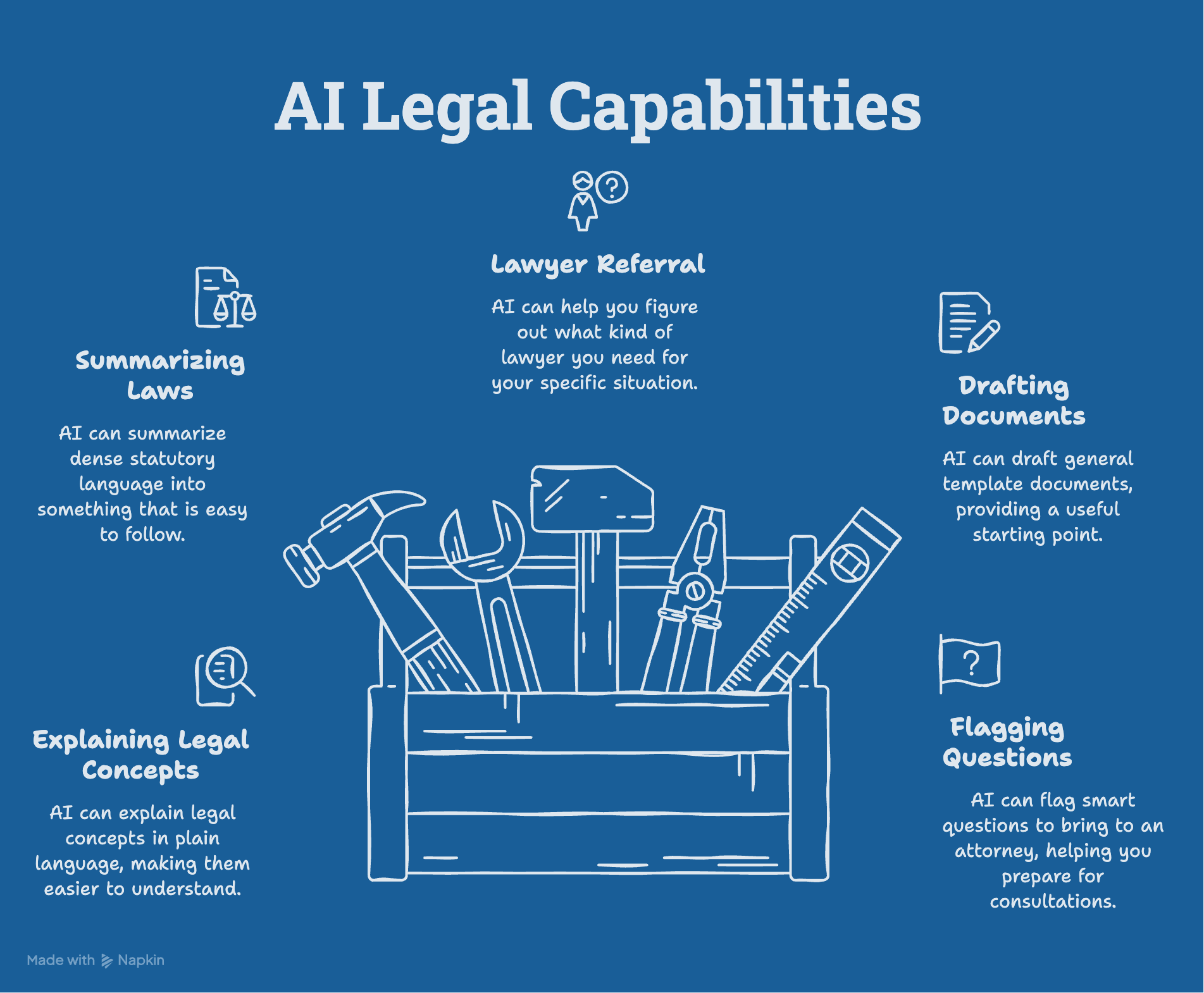
Explaining legal concepts in plain language. Ask what "indemnification" means or how small claims court works, and you'll get a clear, readable explanation in seconds.
Summarizing publicly available laws and regulations. AI can take dense statutory language and turn it into something you can actually follow.
Helping you figure out what kind of lawyer you need. Employment dispute? Landlord issue? Business formation? AI can point you toward the right type of professional.
Drafting general template documents. A basic non-disclosure agreement or a simple letter outline can give you a useful starting point.
Flagging smart questions to bring to an attorney. This might be the most underrated use of all — it helps you walk into a consultation prepared.
These use cases are valuable, and they're growing fast. AI is increasingly built into legal research platforms and document tools that professionals rely on every day.
The trick is keeping expectations honest. What you're getting here is helpful orientation — not AI legal advice tailored to your situation. Used this way, AI is a fantastic research assistant. It gets you informed and ready, which is exactly what it's good at.
TL;DR: AI can be a genuinely useful tool for understanding legal concepts, but it cannot replace a licensed attorney who applies the law to your specific facts. This article draws a clear line between helpful legal information and actual legal advice — and it's most useful for anyone tempted to act on an AI answer before talking to a professional.
How to Use AI for Legal Questions Without Crossing Into Dangerous Territory
So how do you get the upside without the downside? Use this simple framework.
Use AI to get oriented first. Before you ever speak to a professional, let AI help you understand the landscape, learn the terminology, and grasp the basics. You'll walk into that conversation far more prepared.
Draft your questions for a lawyer. Ask AI to help you build a list of sharp questions to bring to an attorney. This makes professional time more efficient — and often cheaper.
Treat output as a starting point, never a final answer. Whatever AI gives you is a first draft of your understanding, not a conclusion you can bank on. Keep that framing front and center.
Always verify jurisdiction and date. Ask the tool which jurisdiction its answer applies to and whether the information is current. Then confirm it against an official source. If it can't tell you, treat the answer with extra caution.
There's a genuinely encouraging side to all this, too. Some legal aid organizations are now using AI carefully to help underserved communities access basic legal information they couldn't otherwise afford. Applied thoughtfully, the technology can widen access to justice — which is a real win.
The Line Is Real — and Worth Respecting
So, can AI give legal advice? The honest answer is that the question itself misses the point.
The real question isn't whether AI is useful in legal contexts — it clearly is. It's whether you understand what you're actually getting when you use it. The most informed users aren't the ones who avoid AI or the ones who trust it blindly. They're the ones who know precisely where it helps and where it stops.
Treat AI as a highly capable research assistant. Let it explain, summarize, draft, and prepare you. Then hand the actual judgment — the part where the law meets your specific facts — to qualified counsel.
That clarity isn't a limitation. It's a strength. When you know exactly what your tools do well, you use them better, move faster, and protect yourself in the process. Use AI to get smart. Use a lawyer to stay safe.
Where AI Cannot Go — and Why the Law Draws That Line
Now the hard limits. These aren't arbitrary — they exist for solid reasons.
AI can't assess how the law applies to your specific facts. Two situations that look nearly identical can have completely different outcomes based on small details. A real attorney spots those details. AI often can't.
AI struggles with jurisdiction-specific nuance. A rule that holds in one state, country, or court may be flatly wrong somewhere else. AI tools frequently blur these lines without telling you.
AI can't be held accountable. This is the big one. If a licensed attorney gives you bad guidance, there's professional indemnity insurance, a bar complaint process, and real recourse. If an AI tool gets it wrong and you act on it? There's none of that. No insurance, no complaint to file, no one to answer for the outcome. The risk lands entirely on you.
AI can't replace professional judgment or ethical duties. Lawyers carry obligations to act in your interest, keep your information confidential, and avoid conflicts. An AI tool has no such duties.
This is exactly why many AI tools explicitly disclaim legal advice right in their terms of service. They're not being modest — they're being accurate about what they can and can't responsibly do.
The Grey Zone — Where It Gets Genuinely Complicated
Not everything fits neatly into "information" or "advice." Some cases are genuinely murky, and it's worth being honest about that.
Consider AI-powered platforms built specifically for legal use — contract review tools, immigration assistants, and similar products. These are designed to do more than explain concepts. They analyze documents and surface issues, which starts to look a lot like applying law to facts.
Then there are AI tools used inside law firms for research and drafting. Here, a licensed professional reviews the output before it reaches a client, which keeps things on solid ground. The human stays in the loop.
The harder debate is whether sophisticated AI responses, on their own, cross into unlicensed practice. Regulators in the US, UK, and EU are actively wrestling with this. There's no settled answer yet.
The fair takeaway isn't alarm — it's awareness. The technology is moving faster than the rules can keep up. That gap doesn't make AI dangerous by default, but it does mean you can't assume a tool is "allowed" to do something just because it can.
Real Risks of Getting This Wrong
Let's make this concrete, because the stakes are real.
Imagine an AI tool tells you that you have 90 days to file a claim, when your jurisdiction actually allows only 30. You relax, wait, and miss the deadline entirely. That window may be gone for good.
Or picture signing a contract after asking AI to "check it for problems." It misses an auto-renewal clause or an unfavorable liability term. Now you're locked into something you didn't fully understand.
Or you act on a law that AI described accurately — as it existed two years ago. The statute has since been amended. Your action is now based on a rule that no longer applies.
Here's what makes legal contexts especially tricky: AI hallucination. AI tools sometimes invent case law, cite statutes that don't exist, or produce confident-sounding references that are simply wrong. A trained lawyer catches these instantly. A non-expert almost never does.
None of this means you should avoid AI. It means you should understand the risk clearly. The danger isn't using AI — it's mistaking its confidence for accuracy and acting before you verify.
FAQs - Can AI Give Legal Advice?
Is it legal for AI companies to offer legal information tools?
Yes, generally. Providing legal information — general explanations of laws and processes — is allowed and widely available. The line companies have to watch is the shift into legal advice tailored to a specific person, which can trigger unauthorized practice of law concerns. That's why many tools include clear disclaimers.
Can I use AI to help write a contract or legal document?
You can use AI to draft a general template or a first version, and that's a reasonable starting point. The important step is having a qualified attorney review anything that carries real consequences. AI can miss critical clauses, jurisdiction-specific requirements, or terms that quietly work against you.
Are AI-generated legal answers covered by attorney-client privilege?
No. Attorney-client privilege protects confidential communications with a licensed lawyer acting in that role. An AI tool is not your attorney, so conversations with it generally aren't privileged. Be thoughtful about what sensitive details you share, since those protections simply don't apply.
Which AI tools are designed specifically for legal use?
There's a growing category of purpose-built legal AI tools, including contract review platforms, legal research assistants, and immigration help tools used by firms and individuals. Many are designed to work alongside professionals rather than replace them. Always check whether a tool is meant for professional oversight or general consumer use before relying on it.
Will AI eventually be licensed to give legal advice?
It's an open question that regulators are actively debating. For now, licensing frameworks are built around human professionals with accountability and ethical duties that AI can't yet replicate. The rules may evolve as the technology matures, but we're not there today.