How to Use AI in Marketing: A Practical Guide for Every Marketer
MARKETING
Asking AI Team
7/2/20267 min read


Marketing has always rewarded speed, creativity, and knowing your audience. AI does not change that. What it does is give marketers more of all three — faster content, sharper targeting, and data that actually informs decisions instead of just filling dashboards.
But the gap between knowing AI exists and knowing [how to use AI in marketing](PRIMARY URL) effectively is where most people get stuck. Too much hype, not enough clarity. This guide skips the hype and gets into what is actually working — from the tools marketers are using every day to the skills that still need a human behind them.
Why AI Has Become a Marketing Essential, Not a Nice-to-Have
Two years ago, AI in marketing was something early adopters experimented with on side projects. In 2026, it is the default way serious marketing teams operate. According to Salesforce's State of Marketing 2026, 87% of marketers now use generative AI in at least one recurring workflow — up from just 51% in 2024. That is not a trend. That is a shift in how the work gets done.
The reasons are straightforward. Brands need more content, across more channels, for more specific audiences than ever before. Doing that manually, at scale, is not realistic for most teams. AI closes that gap — not by doing the thinking, but by handling the heavy lifting so marketers can spend time on strategy instead of production.
Speed is part of it. So is personalization. When a campaign can adapt messaging based on real-time audience data instead of a quarterly review, results improve. When email subject lines are tested automatically and the better one wins without manual A/B setup, teams move faster. These are not abstract benefits — they show up in ROI. McKinsey's Global AI Survey reports that AI content drafting delivers 3.2x ROI on average, with personalization tools not far behind at 2.7x.
If you have been thinking about AI as a tool for bigger companies with bigger budgets, it is worth reconsidering. Getting practical AI business advice before committing to a tool or workflow is smart — and that same mindset applies to marketing: start with the problem you are trying to solve, not the tool everyone is talking about.
TL;DR: AI has moved from an experiment into everyday marketing practice, and 87% of marketers now use it in at least one workflow. This guide breaks down the tools doing real work, what AI genuinely cannot do, and how to get started without overcomplicating it.
How to Leverage AI in Marketing — A Practical Starting Point
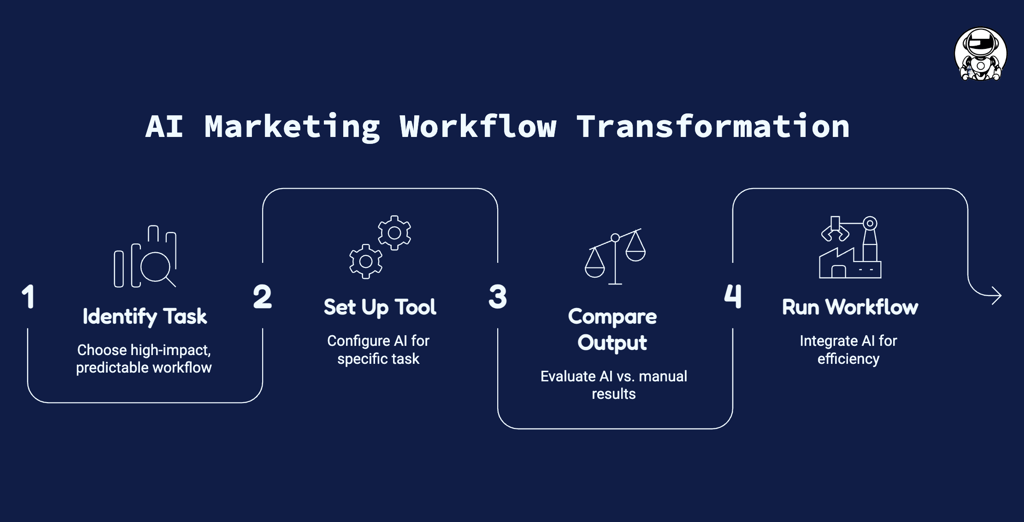
The phrase how to leverage ai in marketing sounds big. The reality of starting is much smaller. Pick one workflow. One. Run it with AI for two weeks. Then assess.
Here is what a week-one approach looks like for most marketers:
Day 1–2: Identify the task that takes the most time and produces the most predictable output. For most teams, that is either first-draft writing or reporting. Choose one.
Day 3–4: Set up the tool. If it is content, that means a tool like Jasper or ChatGPT with a well-constructed prompt that includes your brand voice, audience, and goal. If it is reporting, that means connecting your analytics platform to an AI layer.
Day 5: Compare what AI produces against what you would have produced manually. Look for gaps — specificity, accuracy, brand voice — and note what needs editing.
Week 2: Run the full workflow with AI assistance and track time spent. Most marketers find they cut production time by 40–60% on the tasks they start with.
Side-by-side, the difference is usually not in the quality of the final output — it is in how quickly you arrive there. A blog post that took four hours now takes ninety minutes. A monthly report that required half a day gets drafted in twenty minutes. That time goes back into strategy, client work, and the parts of marketing AI cannot touch.
Where AI in Marketing Is Heading Next
The tools available today are the starting point, not the ceiling. A few directions worth watching:
Predictive audience segmentation. Instead of segmenting based on past behavior, AI models are getting better at predicting which audience groups are most likely to convert before a campaign launches — shifting targeting from reactive to proactive.
AI-generated video. Tools like Runway and HeyGen are making video production accessible without large production budgets. Short-form video scripts, spokesperson-style videos, and product demos are being produced at a fraction of previous costs. Quality still requires human oversight, but the gap is closing quickly.
Real-time personalization. Website content, ad creative, and email messaging that adapts dynamically to individual users in real time — not based on segments, but on individual behavior — is becoming standard in enterprise platforms and trickling down to mid-market tools.
Agentic workflows. 34% of enterprise marketing teams now run at least one autonomous AI agent — a system that plans and executes multi-step tasks without constant human prompting. Campaign analytics, content briefs, and lead qualification are the most common uses. This is where AI goes from assistant to operator.
Now You Know — Here Is What to Do
Reading about AI is not the same as using it. The marketers seeing real results are the ones who started somewhere specific, iterated, and built from there.
Pick one task. Open one tool. Give it a real prompt with real context about your brand and your audience. See what comes back. Edit it. Publish it. Then do it again.
The gap between marketing teams that use AI well and those that do not is not about access to better tools. It is about the habit of using them consistently and with enough intention to make them useful. Start there, and the rest follows naturally.
The AI Marketing Stack — What Tools Actually Do the Work
The most common question marketers ask when getting started is: what are the best ai tools for marketing? The honest answer is that it depends on where you spend most of your time. Here is how the main categories break down.
Content generation. Tools like Jasper, Writer, and Copy.ai help teams produce first drafts of blog posts, ad copy, social captions, and product descriptions faster than starting from scratch. These are not publish-and-forget solutions — the best results come when a human edits, adds specifics, and injects brand voice. Teams using AI content tools produce 4.1x more published content per marketer per month, per HubSpot AI Trends 2026.
SEO and content optimization. Platforms like Surfer SEO, Clearscope, and Frase help writers hit the right topics, terms, and structure for search performance. They analyze top-ranking content and guide writers on what to include — taking the guesswork out of on-page optimization.
Email personalization. Tools embedded in platforms like HubSpot and Salesforce Einstein automatically adapt email content, subject lines, and send times based on individual subscriber behavior. AI-powered email workflows save time on segmentation while improving open and click rates.
Ad creative and optimization. Google's Performance Max and Meta's Advantage+ campaigns use AI to test ad variants, adjust bids, and allocate budget toward the combinations that convert. Marketers still set the creative direction — AI handles the iteration and optimization in real time.
Analytics and reporting. Instead of spending hours pulling data into spreadsheets, tools like Adobe Analytics with AI Insights and HubSpot's reporting suite surface patterns, flag anomalies, and generate summaries automatically. The average marketer saves 6.1 hours per week using AI tools, according to HubSpot — with content marketers saving closer to 7.8 hours.
The Honest Answer to 'Will AI Replace Marketing Jobs'
The question will ai replace marketing jobs is reasonable, and it deserves a straight answer: AI is replacing specific tasks, not entire roles — at least not yet, and not in the way most people fear.
What is actually happening is a reshaping of who does what. Gartner's CMO Spend Survey 2026 found that 23% of agencies reduced junior copywriting headcount in 2025, with 31% planning further reductions in 2026. At the same time, demand for senior content strategists grew 18% year-over-year, and marketing data analysts grew 21%.
The pattern is clear. AI is taking over production work — first drafts, formatting, basic research, routine reporting. The roles that are growing are those that require judgment, strategy, and the ability to direct AI rather than compete with it. Brand voice, creative direction, audience empathy, and campaign strategy all still need humans. So does knowing when the AI output is wrong, generic, or off-brand.
The marketers who will find AI most disruptive are those who rely heavily on repetitive production tasks and have not started building skills around strategy or data interpretation. The marketers who will find it most useful are those who treat it as a capable assistant — one that needs clear direction and editorial oversight, not a replacement for thinking.
How to Use AI in Marketing FAQs
How much does AI marketing software typically cost?
Most AI marketing tools offer a range of pricing tiers. Entry-level plans for content tools like Jasper or Copy.ai start around $39–$59 per month. Mid-market platform integrations — like HubSpot's AI features or Salesforce Einstein — are typically bundled into existing subscription plans, adding $50–$200 per month depending on the tier. Enterprise tools and custom AI builds run significantly higher. For most solo marketers or small teams, a free trial followed by one paid tool is a sensible starting point.
Does AI-generated content hurt SEO rankings?
It depends on how it is used. Purely AI-generated content published without editing consistently ranks worse than human-written or human-reviewed content. Research from multiple 2026 ranking studies found that unedited AI pages win top-three organic positions 3.1x less often than content with meaningful human editing. The signal Google and other search engines respond to is quality and specificity — not whether AI was involved in production. Human review at 25–45% of word count produces the strongest organic results.
Can a small business with a limited budget actually benefit from AI marketing tools?
Yes, and it is one of the clearest advantages for smaller teams. Solo operators and small marketing teams can now produce content volume, run personalized email campaigns, and generate ad variants that previously required an agency or a larger internal team. Many tools have free tiers that cover basic use cases — ChatGPT, Google's AI features in Search Console, and Canva's AI design tools among them. Starting with one free tool focused on your biggest time drain is a low-risk, practical first step.
What skills do marketers still need alongside AI tools?
Strategic thinking, editorial judgment, and audience empathy are the three most durable skills in an AI-assisted marketing environment. Knowing which ideas are worth pursuing, whether AI output accurately represents the brand, and what an audience actually cares about are all things AI cannot reliably supply. Data literacy is also growing in importance — being able to interpret what AI-generated reports are telling you and act on it confidently is becoming as important as writing or design skills in most marketing roles.