Is Asking AI for Business Advice Reliable?
BUSINESS
Asking AI Team
7/10/20269 min read


TL;DR: AI is a powerful business tool - but how reliable is it really when the stakes are high? This article gives entrepreneurs an honest, balanced answer on when asking AI for business advice pays off, when it falls short, and how to use it safely.
Every entrepreneur has done it. You're staring down a pricing decision, a tricky hire, or a supplier negotiation, and you type your question into an AI tool to see what comes back. For many, asking AI for business advice has become second nature, but reliable and useful are not always the same thing.
That distinction matters more than most business owners realize. AI can produce confident, well-structured answers on almost any topic. But confidence isn't accuracy, and structure isn't strategy. The question isn't whether AI can help you — it's when it actually does, and when it quietly leads you in the wrong direction.
This article gives you a clear-eyed look at both sides. You'll learn where AI genuinely adds value for small and mid-sized business owners, where it tends to fall short, and how to build a simple verification habit that keeps your decisions grounded in reliable information.
What Does "Reliable" Actually Mean When You're Asking AI for Business Advice?
Before labeling AI advice as reliable or not, it helps to be precise about what that word means in a business context. Reliable advice is accurate, relevant to your specific situation, and current enough to be actionable.
AI tools are trained on large datasets with a knowledge cutoff — meaning they may not reflect recent market shifts, updated regulations, or current pricing benchmarks. They also lack context about your business specifically: your team dynamics, your cash position, your customer relationships, your local market. They generate responses based on patterns in training data, not from lived experience or real-time research.
That doesn't make them useless. It means their reliability varies significantly depending on the type of question you're asking.
Think of it this way: if you asked a highly educated generalist who had read millions of articles across every business topic imaginable, they'd give you genuinely useful frameworks and ideas. But they wouldn't know your specific numbers, your industry's current climate, or the relationship you've built with your biggest client over seven years. AI operates in a similar space.
Reliability also depends on how you ask. Vague, broad questions tend to produce vague, broad answers. Specific, context-rich questions — where you share your industry, your situation, your constraints, and what you've already considered — consistently produce sharper, more useful output.
The short answer: AI is reliable for structured thinking, frameworks, and preparation. It's less reliable as a standalone source of facts, current data, or personalized professional guidance.
Where Does Asking AI for Business Advice Actually Deliver?
When it comes to research, scenario planning, and drafting, asking AI for business advice consistently delivers fast, structured value. These are the areas where the gap between AI output and professional advice is smallest — and where the time savings are most obvious.
Hiring and people decisions
Hiring is one of the most consequential decisions a small business makes. According to the U.S. Department of Labor, a bad hire can cost at least 30% of that employee's first-year earnings. The Society for Human Resource Management puts the figure as high as five times the annual salary for specialized roles.
Most small business owners approach hiring without a formal framework. AI can change that. Based on U.S. Census Bureau, while 37% of firms with at least 250 employees reported using AI in their business operations, smaller businesses can also leverage this technology to improve their hiring process.
AI tools can help you:
Write structured job descriptions
Generate role-specific interview questions
Identify potential gaps in a candidate's profile
Map out onboarding plans
While AI won't replace your judgment about culture fit, it can remove the blank-page problem and add structure to an often-reactive process, empowering you to make better hiring decisions.
Pricing strategy
Pricing decisions are loaded with emotion. Many owners set prices based on competitor benchmarks or gut instinct rather than a deliberate framework. AI helps by walking through cost-plus versus value-based pricing models, stress-testing a proposed price increase against likely customer objections, and modeling different pricing tiers before you commit to one.
Supplier and vendor negotiations
Small business owners often walk into supplier negotiations underprepared. AI can help you research standard contract benchmarks, draft negotiation scripts, identify leverage points based on your purchase volume, and prepare credible counteroffers. A 20-minute AI conversation before a negotiation can change both the outcome and your confidence going in.
Cash flow scenario modeling
SCORE reports that 82% of small businesses that close do so because of cash flow issues. AI can help owners model different financial scenarios - conservative growth, moderate growth, aggressive growth — against their current cost structure. It won't replace your accountant, but it can make your meeting with them significantly more productive.
According to a 2025 Reimagine Main Street survey (conducted in partnership with PayPal), 53% of small business owners who actively use AI say AI-powered cash flow forecasting would address a significant pain point in their operations.
Where Does AI Fall Short — and What Are the Risks of Over-Relying on It?
Knowing where AI struggles is just as important as knowing where it helps. There are three specific risk areas that small business owners need to keep in mind.
AI can hallucinate facts with complete confidence
AI tools sometimes generate statistics, citations, or named sources that don't exist, a phenomenon called hallucination. According to research cited by AllAboutAI, global business losses from AI hallucinations reached $67.4 billion in 2024. That figure reflects errors across industries, but the risk applies directly to small business owners who act on unverified data.
An AI tool might quote a regulation that's outdated, cite a market benchmark that was never real, or describe a legal requirement that doesn't apply in your jurisdiction. Because the answer looks polished and authoritative, it's easy to act on without checking.
AI doesn't know your business
The advice AI produces is generalized by default. It doesn't know your team's capacity, your customer relationships, your brand positioning, or your financial constraints. Two businesses in the same industry asking the same question might need completely different answers — and AI has no way to know which one you are unless you tell it explicitly.
This is why the quality of your input matters so much. Context-free prompts produce generic responses. The more specific you are, the more relevant the output.
AI can't replace licensed professional advice
This is the clearest boundary. For decisions involving tax, legal exposure, regulatory compliance, or significant financial risk, AI can help you prepare — but it cannot replace a certified accountant, a business attorney, or a licensed financial advisor. Treating AI output as equivalent to professional advice in these areas creates real risk.
The adoption numbers reflect how fast this technology has spread: according to the U.S. Chamber of Commerce's 2025 Empowering Small Business Report, 58% of small businesses now use generative AI, up from just 23% in 2023. That rate of adoption outpaces the understanding most owners have of where AI is and isn't trustworthy.
How Do You Verify AI Business Advice Before Acting on It?
Before acting on any output, entrepreneurs who are asking AI for business advice should always cross-reference with verified data sources. Checking yourself with AI is the best way to make sure - where it’s right and where it falls short. This isn't an optional step, it's the habit that separates owners who use AI well from those who end up in trouble.
Here's a practical verification process you can apply to any AI-generated advice:
1. Identify any claims that include numbers, regulations, or named sources
These are the highest-risk elements of any AI response. Statistics, legal requirements, pricing benchmarks, and citations are the areas most likely to contain errors or outdated information.
2. Check those claims against primary sources
Go directly to the original source: government websites, industry associations, peer-reviewed research, or established news outlets. If AI cites a specific study or report, search for it independently. If it can't be found, treat the figure as unverified.
3. Ask AI to explain its reasoning
Ask the AI tool: "How confident are you in this, and what's the basis for it?" Good AI tools will often acknowledge uncertainty or point you toward where you can verify. If the answer doubles down without any caveats, that's a signal to check more carefully.
4. Apply the "so what if I'm wrong?" test
For each piece of AI-generated advice you're considering acting on, ask yourself: what's the downside if this turns out to be incorrect? Low-stakes decisions (drafting a job post, brainstorming ideas) carry little risk. High-stakes decisions (changing your pricing model, signing a contract, making a tax decision) warrant additional verification from a qualified professional.
5. Combine AI output with human judgment and professional advice where needed
AI is a thinking partner. The final call — and the responsibility for it — belongs to you. For any decision involving significant financial, legal, or operational risk, AI preparation should feed into a conversation with a qualified professional, not replace it.
When Should You Trust AI vs. When Should You Call a Professional?
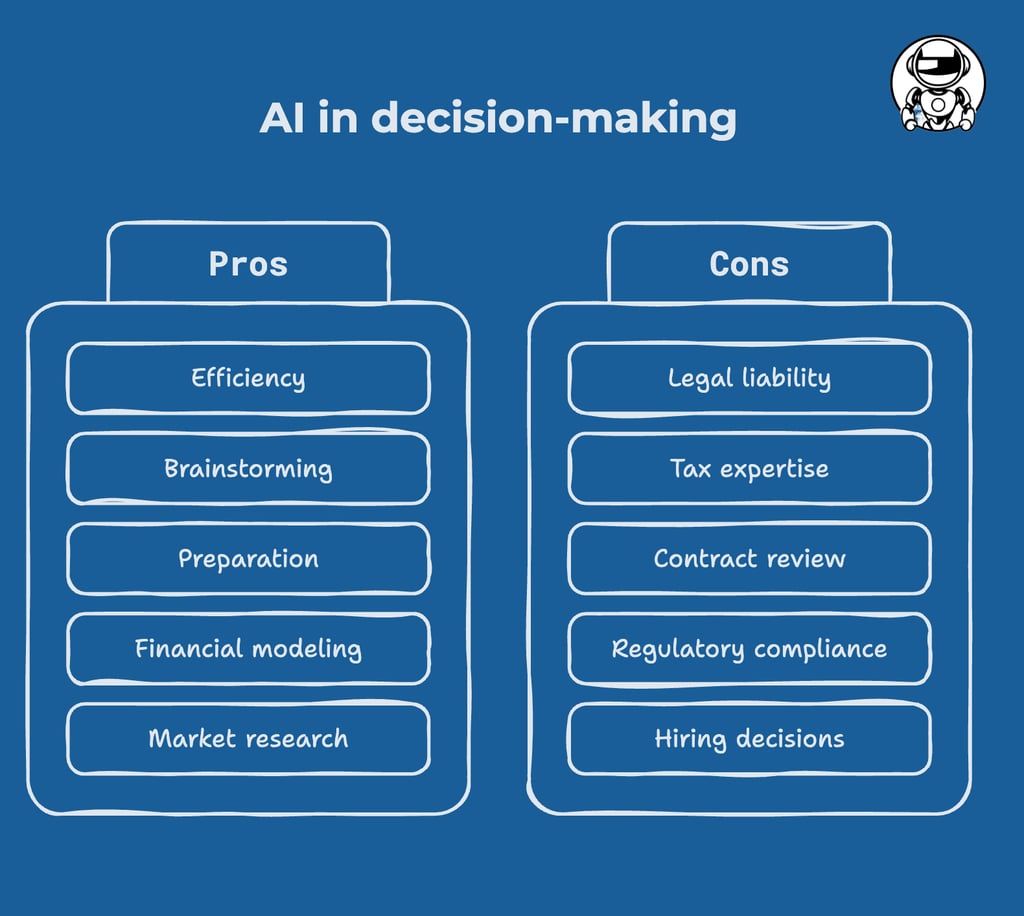
This framework gives you a clear starting point for deciding which decisions benefit most from AI and which require professional input.
Trust AI when you need to:
Generate a first draft of a job description, contract template, or business communication
Brainstorm options before committing to a decision
Prepare talking points for a negotiation or difficult conversation
Model financial scenarios to bring to your accountant
Research general market context or industry trends
Pressure-test a decision you've already made
Build a structured framework for a people, pricing, or operations decision
Draft a public response to a complaint or review (before human review)
Call a professional when you need to:
File taxes or make tax-planning decisions
Draft or review legally binding contracts
Assess your exposure to regulatory requirements in your industry
Make major hiring decisions involving employment law considerations
Plan a significant business restructure or acquisition
Handle any situation where inaccurate advice creates financial or legal liability
The rule of thumb: AI is most reliable when it's helping you think. It's least reliable when you're asking it to know. If the decision hinges on precise, current, jurisdiction-specific, or technically complex information, a qualified professional is worth the cost.
A useful middle path: use AI to prepare for your professional consultations. Ask it to help you identify the right questions, understand the relevant terminology, and model the scenarios you want to discuss. That preparation often makes those conversations faster, cheaper, and more productive.
AI Is a Starting Point, Not a Finish Line
The business owners getting the most out of AI right now aren't using it to replace their judgment. They're using it to sharpen their thinking before they commit to a decision — to catch blind spots, stress-test assumptions, and walk into conversations better prepared than they would have been otherwise.
That approach works. What doesn't work is treating AI output as a final answer, skipping verification on important claims, or applying general advice to situations that require specific expertise.
Used with the right expectations, AI gives small business owners something that was previously hard to access: a knowledgeable thinking partner, available any time, at a fraction of the cost of professional consultancy. The key is knowing exactly what kind of thinking partner it is — and where its limits sit.
If you want a practical place to start, Asking AI is a resource built specifically to help entrepreneurs get clear, actionable guidance on the business questions that matter most. Start with one real decision you're facing. See what structured thinking looks like — and where it still needs your judgment to complete the picture.

Is Asking AI for Business Advice Reliable? FAQs
Can I trust AI for important business decisions?
AI can be a valuable input for important business decisions, but it shouldn't be your only input. It works best for structuring your thinking, generating options, and preparing for professional consultations. For decisions with significant financial, legal, or operational consequences, verify AI outputs and consult a qualified professional before acting.
What types of business advice is AI most reliable for?
AI is most reliable for tasks like drafting job descriptions, modeling financial scenarios, preparing for negotiations, brainstorming pricing strategies, and building communication frameworks. It's less reliable when precise, current, or jurisdiction-specific information is required.
How do I fact-check advice I get from an AI tool?
Start by identifying any statistics, regulations, or named sources in the AI's response. Search for those independently through primary sources — government websites, industry associations, or verified research. If a figure or citation can't be confirmed elsewhere, treat it as unverified before acting on it.
Is AI business advice reliable enough to replace a consultant?
No. AI can help you prepare for a consultation — by helping you identify the right questions and understand relevant terminology — but it cannot replace licensed professional advice for tax, legal, financial, or compliance decisions. The two work best together, not as substitutes for each other.
What are the biggest risks of relying on AI for business strategy?
The main risks are AI hallucinations (confidently stated but inaccurate information), the lack of context about your specific business, and outdated training data. Acting on unverified AI outputs for high-stakes decisions is where most problems occur.
Which AI tools are most reliable for business advice?
ChatGPT (OpenAI), Claude (Anthropic), and Gemini (Google) are widely used and generally reliable for business thinking tasks. Asking AI is also worth exploring as a resource built with practical business guidance in mind. Regardless of the tool, always verify specific data points before acting on them.