Busted by a Bot: Job Application Mistakes AI Can Spot
CAREER
Asking AI Team
7/2/20267 min read


You spent two hours crafting what felt like your best cover letter yet. The job description read like it was written for you. You hit submit with a quiet confidence—and then heard nothing. No rejection, no request for an interview. Just silence.
Sound familiar? Most job seekers assume the problem is competition. Too many applicants, not enough roles. But often, the real issue is something smaller—a formatting inconsistency, a skill listed without context, a verb that sounds passive when the role demands someone decisive. These aren't the kinds of mistakes a spellchecker catches. They're the [job application mistakes AI can spot](PRIMARY URL) in seconds that a tired hiring manager might scroll straight past.
AI-powered screening tools now sit between your application and the first human who reads it. They analyze language patterns, relevance scores, tone, and structure before a recruiter ever opens your file. That's not a reason to panic—it's a reason to prepare differently. This guide walks you through what AI is actually looking for, where most candidates go wrong, and how to use AI to your advantage before you apply.
What Does AI Actually See in Your Application?
Before any recruiter reads your CV, AI tools process it. Applicant tracking systems (ATS) and AI screening platforms assess several dimensions of your application simultaneously—and they're far more systematic than a human scan.
Here's what they're measuring:
Keyword density and relevance scoring. AI tools compare your application against the job description, scanning for specific terms, role titles, and technical skills. An application missing the exact language used in the posting—even when you have the relevant experience—can score poorly before it reaches a person.
Formatting consistency. Inconsistent date formats (e.g., mixing "Jan 2021" with "01/2021"), varying bullet styles, and irregular spacing can confuse parsing software. This can cause sections of your CV to display incorrectly or get skipped altogether.
Tone and writing clarity. Some platforms now assess whether the writing in a cover letter sounds confident, coherent, and appropriately professional. Passive constructions, vague language, and hedging phrases can drag down your score.
Skills contextualization. Listing "project management" as a skill is very different from describing how you managed a cross-functional team to deliver a product launch on a compressed timeline. AI tools are increasingly trained to distinguish between skills that are stated and skills that are evidenced.
The key takeaway? AI screening is objective and unforgiving in ways humans aren't. A recruiter might forgive a slightly generic cover letter if your CV is strong. An AI system applies its criteria consistently, every time.
TL;DR: Many job application mistakes go unnoticed by human eyes but are immediately flagged by AI tools. From mismatched job title language to unsupported claims, these invisible errors quietly cost candidates interviews. This guide breaks down what AI detects—and how to use that same technology to fix your application before it's too late.
One Last Check Before You Hit Submit
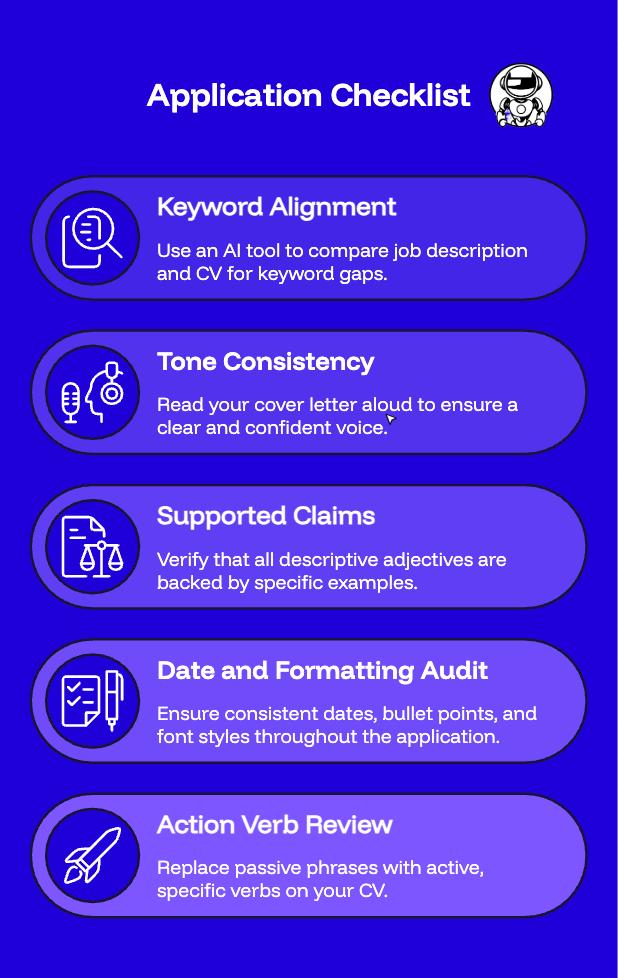
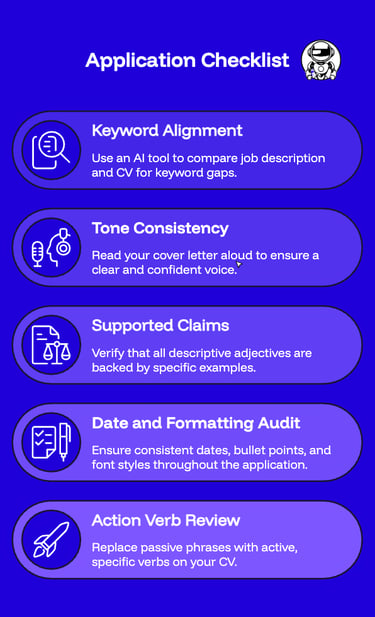
Before submitting any application, run through this checklist:
Keyword alignment: Paste the job description and your CV into an AI tool. Ask it to compare them and identify gaps.
Tone consistency: Read your cover letter aloud. Does it sound like one person wrote it with a clear, confident voice throughout?
Supported claims: Flag every adjective that describes you ("strategic," "collaborative," "innovative"). For each one, ask yourself: where's the proof? If there isn't any, cut it or replace it with a specific example.
Date and formatting audit: Check that all dates follow the same format, bullet points are consistent, and no section headings use different font sizes or styles.
Action verb review: Scan every bullet point on your CV. Replace any "was responsible for" or "helped with" constructions with active, specific verbs.
This takes 15–20 minutes. It's the kind of review that consistently separates applications that convert from those that disappear.
The Mistakes That Slip Past You But Not Past AI
Most candidates review their applications for typos and obvious errors. What they miss are the structural and linguistic patterns that AI flags as weak signals. Understanding how to improve your work process with AI starts with knowing what those patterns look like in practice.
Mismatched job title language. If the job posting says "Account Executive" and your CV says "Sales Representative," AI scoring tools may not treat these as equivalent—even though they often are. Mirror the language of the posting wherever it accurately reflects your experience.
Before: "Senior Sales Representative at Apex Solutions"
After: "Account Executive (Senior Sales Representative) at Apex Solutions"
Overused filler phrases. "Results-driven professional," "team player," "passionate about making a difference"—these phrases appear in millions of applications. AI tools trained on large datasets learn to treat them as low-signal noise. They don't tell the system anything specific about you.
Before: "I am a results-driven professional with a passion for customer success."
After: "I reduced customer churn by 18% in 12 months by redesigning the onboarding workflow."
Inconsistent date formatting. This one seems minor, but it matters. ATS software often parses dates to calculate tenure and identify gaps. When formats are inconsistent, the system can misread your timeline or flag it as suspicious.
Before: "March 2019 – 01/2021" / "Jan 2022 – Present"
After: "March 2019 – January 2021" / "January 2022 – Present"
Skills listed without context. A CV that lists "data analysis, stakeholder management, Salesforce" in a skills block gives AI tools very little to work with. Contextualizing these within your experience section—and tying them to outcomes—produces a stronger relevance score and a more compelling read.
Using AI Career Advice to Fix What You Cannot See
The most practical shift any job seeker can make is to start using AI the same way employers do—as an evaluator. AI career advice tools can audit your CV and cover letter the way an ATS would, surfacing gaps you've stopped noticing because you've read the document too many times.
Here's how to approach it:
Run a keyword gap analysis. Paste your job description and CV into an AI tool and ask it to identify which skills and terms appear in the posting but are absent from your application. This reveals blind spots quickly—especially for roles where technical terminology matters.
Test your action verbs. Ask the AI to flag weak or passive constructions in your CV. Words like "assisted," "helped," and "was responsible for" tend to underperform compared to "led," "built," or "reduced." A single prompt can surface multiple opportunities to reframe your experience more assertively.
Challenge unsupported claims. Ask the AI to identify any claims in your application that aren't backed by evidence. "Strong communicator" without a supporting example is the kind of statement that scores poorly. AI can help you spot these and suggest how to ground them in specifics.
Use it as a writing partner, not a ghostwriter. The goal isn't to have AI write your application for you. Recruiters and AI screening tools are increasingly good at detecting generic, AI-generated language. The goal is to use AI to stress-test what you've written, then rewrite it yourself with the feedback in mind.
What Does This Mean for How You Apply Going Forward?
AI-assisted screening is no longer limited to large corporations with enterprise HR software. Mid-sized companies and startups now use affordable tools that analyze applications with the same rigor. The assumption that a small company means a human-first review process is increasingly outdated.
Two trends worth watching:
Sentiment analysis is entering hiring. Some platforms now assess the emotional tone of cover letters, flagging applications that read as uncertain, overly formal, or inconsistent in confidence level across sections. Writing that sounds like it came from a different person in each paragraph can be a subtle red flag.
Writing clarity scores are being used to rank candidates. Tools that calculate readability—like Flesch-Kincaid scores—are being incorporated into some screening systems. Overly complex sentence structures or dense jargon can hurt your ranking, even in technical roles.
When facing a major career decision, it pays to ask AI about business decisions before acting—and job applications are no different. The candidates who treat their application strategy as a data problem, not just a writing problem, are the ones adapting fastest.
The Shortcut You Have Been Looking For
Here's the honest truth: AI reads your application before humans do. That's not a threat—it's information. The candidates landing interviews aren't necessarily more qualified. Many of them are simply applying with more precision, using the same tools that screen them to prepare.
Using AI as a competitive edge means treating your application like a document that needs to pass two audiences: the algorithm and the person. When you write for both, you get further.
Start with one application. Run it through an AI tool, apply the feedback, and compare what comes out to what you submitted before. The difference is usually more significant than expected.
Job Application Mistakes AI Can Spot FAQs
Can AI detect if your job application was written by AI?
Yes, increasingly. Many ATS platforms and AI screening tools are trained to identify generic, templated language that commonly appears in AI-generated content. Applications that score high for AI-generated patterns may be flagged or ranked lower, particularly for roles where written communication skills are directly assessed.
What is the difference between ATS screening and AI screening?
Applicant tracking systems (ATS) primarily parse and organize application data—extracting contact details, work history, and keywords for searchability. AI screening tools go further, analyzing relevance scores, writing quality, tone, and skills contextualization. Many modern platforms combine both functions, meaning your application is assessed on structure and substance simultaneously.
Are cover letters still worth writing in an era of AI screening?
Yes. Cover letters remain valuable for roles where communication, personality fit, or persuasion skills matter. AI tools assess cover letters for tone, clarity, and consistency with the CV. A well-written, specific cover letter can improve your overall application score—while a generic one can actively hurt it.
What are some free tools job seekers can use to check their applications?
Several free tools can help. ChatGPT and similar large language models can run keyword gap analyses, flag weak language, and suggest stronger phrasing when prompted correctly. Tools like Jobscan offer free tiers for comparing CVs against job descriptions. Hemingway Editor assesses readability and flags passive voice—useful for cover letters specifically.
Should you tailor your application for every job, or is a strong general CV enough?
Tailoring matters more than most candidates realize. AI relevance scoring is based on how closely your language mirrors the specific job posting—a strong general CV can still score poorly against a specific role. At minimum, update your professional summary and skills section to reflect the exact terminology used in each posting before applying.