How Many Companies Use AI for Marketing? (2026 Data + Top Tools Ranked)
MARKETING
Asking AI Team
7/8/202613 min read

TL;DR: AI has gone from an experiment to a marketing essential. In 2026, 88% of marketers use AI tools daily, the global AI marketing market is worth $47 billion, and companies using AI publish 42% more content per month than those that don't. This guide covers the numbers, the growth trajectory, the top tools ranked, and a practical how-to for building your own AI marketing stack.
The short answer: nearly all of them
If you had asked this question in 2021, the honest answer would have been "a small but growing minority." Ask it in 2026 and the data tells a very different story.
88% of digital marketers now use AI in their day-to-day roles, and 78% of businesses use AI in at least one business function. In the US specifically, that figure climbs even higher — 74% of American marketers use AI regularly. Non-adoption has stopped being a strategic choice and started looking like a competitive liability.
The scale of investment reflects that shift. Global AI in marketing revenues are estimated at approximately $47 billion in 2025, with projections putting that figure above $107 billion by 2028. That kind of trajectory does not happen through casual experimentation — it happens when organizations are seeing measurable returns and doubling down.
Perhaps the most telling number: 92% of businesses intend to invest in generative AI tools over the next three years. The question of whether AI belongs in marketing has been answered. The question now is where, how, and with which tools.
How fast is AI adoption in marketing growing?
The demand for AI marketing advice is accelerating as AI adoption continues to surge. According to Duke University's CMO Survey 2025, generative AI usage in marketing grew 116% year over year, expanding from 7.0% to 15.1% of all marketing activities. The momentum extends beyond marketing: 78% of businesses worldwide now use AI in at least one business function, up from 55% in 2024. A 23-percentage-point increase in just one year isn't gradual growth—it's a clear sign that AI has reached a tipping point and is becoming essential for modern marketing and business success.
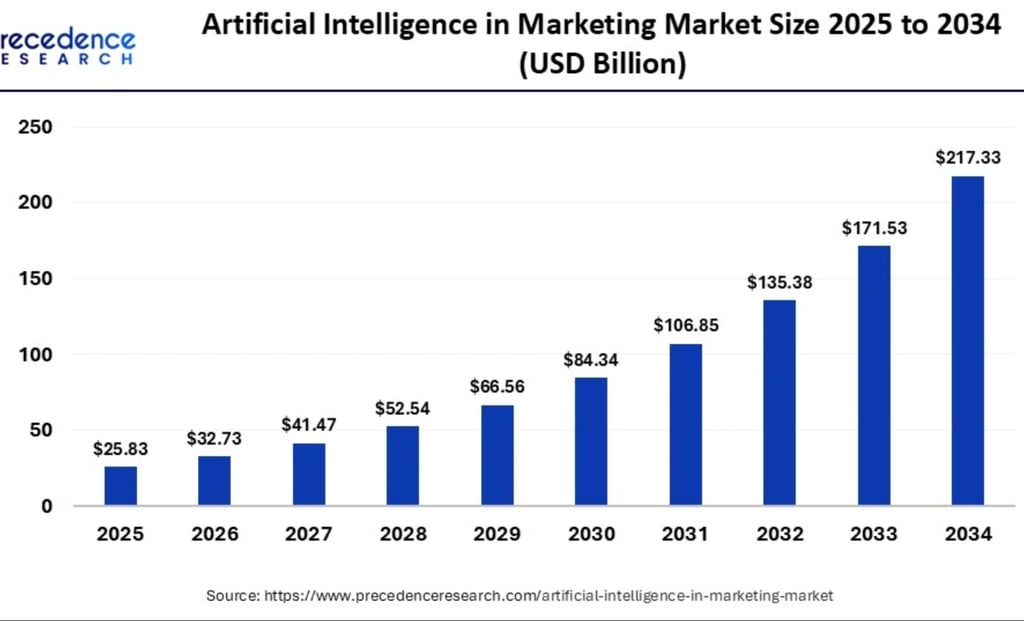
The market projections confirm that momentum. The global AI marketing market is valued at $25.83 billion in 2025 and is on track to hit $217.33 billion by 2034, an 8x expansion in under a decade. The AI in the marketing market is growing at a 37.2% compound annual growth rate — 2.5x faster than the broader marketing technology industry.

Regional differences are worth noting. North America leads globally with 84% marketer AI adoption, driven by early access to tools and larger tech budgets. Asia-Pacific is the fastest-growing region for AI marketing adoption, with a 67% year-over-year increase led by Singapore, South Korea, and Japan.
The bottom line: this is not a tech trend or an early-adopter story anymore. Marketing AI adoption has passed the point where non-adoption is a viable competitive posture.
What are companies actually using AI for?
Adoption rates are one story. What marketers are doing with these tools is another, and the use cases are broader than most people outside the industry realize.
Content creation is the most widespread application. 93% of marketers use AI specifically to speed up content creation. Companies using AI publish 42% more content each month, and AI allows companies to publish 47% more content per month according to Semrush's 2026 data.
Email marketing has seen particularly strong AI integration. Over 80% of marketers use AI for email copy, and AI-written emails show a 41% higher click-through rate compared to non-AI-written emails.
SEO and search performance is another major area. 65% of businesses saw an uplift in SEO performance due to AI marketing tools, and 68% of businesses have seen increased content marketing ROI from AI.
Paid advertising and audience targeting round out the core use cases. AI campaigns produce 32% more conversions through better audience segmentation, and customer acquisition costs drop 29% with AI-optimized campaigns.
The productivity gains are concrete and measurable. Average marketers save 6.1 hours per week using AI tools — roughly 317 hours per marketer per year, or nearly 8 working weeks. Teams using AI strategically see 44% productivity gains, and companies using AI for marketing report a 37% reduction in overall marketing costs.
Top AI marketing tools in 2026: ranked and reviewed
With hundreds of tools on the market, knowing which ones actually deliver is the practical challenge. Here are the tools consistently topping the rankings in 2026, grouped by what they do best.
1. HubSpot
Best overall for growing teams
Rating: 4.6/5
Starting price: from $800/month (Professional)
HubSpot is the top overall pick because it connects AI with CRM, marketing automation, content, customer data, and reporting. For teams that want a single platform rather than a patchwork of tools, nothing else comes close. AI features are embedded throughout: email copy generation, lead scoring, content suggestions, and campaign reporting. The limitation is cost — the Professional tier is a meaningful investment for smaller teams.
Best for: Growing businesses that want marketing, CRM, and automation in one place.
4. Canva AI
Best for design and visual content
Rating: 4.4/5
Starting price: Free (Pro from $15/month)
Canva's free tier is the most useful free marketing AI tool available — you get design generation, AI writing, and basic editing tools at no cost. The AI features handle background removal, image generation, design resizing across formats, and copy suggestions, all within a workflow that requires no design training. For social media visuals, presentation decks, and ad creative, Canva removes the bottleneck that most small and mid-size teams hit when design resources are limited.
Best for: Any team producing social, email, or paid creative without a dedicated design function.
2. Semrush
Best for SEO and AI search visibility
Rating: 4.0/5
Starting price: ~$248/month (Pro)
Semrush ships a 2026 AI Visibility Toolkit that tracks how your brand appears across ChatGPT, Google AI Overviews, and Perplexity. The platform covers keyword research, competitor analysis, content creation, technical audits, and now AI answer engine optimization in a single dashboard. The Semrush Copilot flags declining keywords, technical issues, and content gaps in a prioritized feed — roughly 2 to 3 hours saved per week on routine auditing.
Best for: Marketing teams and agencies where organic search is a primary growth channel.
3. Jasper
Best for content production at scale
Rating: 4.3/5
Starting price: $59/month (Pro)
The case for Jasper is not raw output quality — it is consistency at scale. Feed it your brand style guide and tone parameters and it holds the line across blog posts, email sequences, ad copy, and product descriptions in 30+ languages, simultaneously, across ten campaigns. The native Surfer SEO integration means content can be optimized as it is written. For a 10-person marketing team producing content across email, social, ads, landing pages, and blog posts, Jasper's value is consistency — every piece follows your brand voice, uses approved messaging, and matches your style guide.
Best for: Teams of 5+ producing high volumes of multi-channel branded content.
5. Surfer SEO
Best for SEO content writing
Rating: 4.2/5
Starting price: ~$99/month
Surfer is the most practical SEO content platform for teams that want to write and optimize in the same place. It covers content scoring, AI SEO optimization, internal linking, and AI visibility tracking across ChatGPT, Perplexity, Google AI Mode, AI Overviews, and Gemini. Where Semrush gives you the strategy layer, Surfer sits at the execution layer — helping writers produce content that actually ranks while they are writing it.
Best for: Content teams where SEO is embedded in the writing process, not bolted on afterwards.
6. Grammarly
Best for content quality control
Rating: 4.3/5
Starting price: Free (Business from ~$12/user/month)
Grammarly has evolved well beyond grammar checking — it is now an AI-powered editing layer that handles tone adjustment, content rewriting, generative drafting, and brand voice enforcement across your entire team's output. The Business tier adds team-level analytics and brand voice profiles, making it genuinely useful for managing content quality at scale. Think of it as the quality assurance layer that sits on top of any other AI writing tool.
Best for: Every content marketer — it pairs with any AI writer as a quality and consistency check.
7. ChatGPT (Plus / Team)
Best for general-purpose AI assistance
Rating: 4.1/5
Starting price: $20/month (Plus)
ChatGPT remains the most dominant AI chatbot in the marketing sector worldwide, with 88% of users. Its breadth is its strength — brainstorming, first drafts, research summaries, competitor analysis frameworks, ad copy variations, email subject line testing. The limitation is that it lacks the marketing-specific features, brand voice enforcement, and CRM integration that purpose-built tools offer. For solo marketers or small teams on a budget, it covers a remarkable amount of ground for $20 a month.
Best for: Individual marketers and small teams needing flexible, low-cost AI assistance.
8. Claude (Anthropic)
Best for long-form reasoning and research-heavy content
Rating: 4.4/5
Starting price: Free (Pro from $17/month)
Claude is Anthropic's AI assistant and one of the strongest options on the market for marketing tasks that require depth, nuance, and extended context. Where most AI writing tools excel at short-form output, Claude handles long documents particularly well — think 10,000-word content audits, detailed competitive analyses, complex campaign briefs, or synthesizing multiple research reports into a single coherent strategy document. Its 200,000-token context window means you can paste in an entire website's worth of content and ask it to find gaps, inconsistencies, or opportunities.
For marketing teams, Claude's strengths show up in a few specific scenarios: drafting thought leadership that needs to sound genuinely considered rather than templated; building structured content frameworks from raw research; editing and improving AI-generated first drafts from other tools; and analyzing lengthy documents like RFPs, competitor reports, or customer research transcripts. The Enterprise version adds SSO, audit logs, and data residency controls for teams with compliance requirements.
Where Claude trails purpose-built marketing tools is in channel-specific integrations — it does not natively connect to your CRM, social scheduler, or SEO platform. It works best as a thinking and writing layer inside a broader stack, paired with tools like Semrush for data and HubSpot for distribution.
Best for: Analysts, strategists, and content leads working on research-heavy, long-form, or high-complexity marketing assets.
9. AthenaHQ
Best for AI search visibility and GEO
Rating: 4.2/5
Starting price: $295/month
AthenaHQ is a Generative Engine Optimization (GEO) platform built specifically for the problem most marketing dashboards do not yet solve: tracking and improving how your brand appears inside AI-generated answers from ChatGPT, Perplexity, Google AI Mode, Gemini, Claude, and Copilot. Founded by former Google Search and DeepMind engineers and backed by Y Combinator, it is one of the more technically credible entrants in the fast-growing AI visibility category.
The platform's Action Center is its most useful differentiator — rather than just monitoring AI mentions, it identifies the specific content gaps preventing your brand from being cited and recommends on-page and off-page fixes. The Shopify and GA4 integrations allow teams to connect AI visibility directly to revenue, which is the measurement piece most GEO tools still cannot close. For enterprise brands already seeing AI Overviews for key queries but lacking control over how they appear, AthenaHQ addresses a real and growing problem.
The honest caveat: the pricing structure — starting at $295 per month with no free trial — effectively positions this as an enterprise tool. Smaller teams evaluating their first GEO investment will likely find better value starting with Semrush's AI Visibility Toolkit or Brand24's AI monitoring features before stepping up to a specialist platform.
Best for: Enterprise marketing teams and agencies with dedicated GEO budgets needing deep AI citation tracking and actionable optimization workflows.
10. Brand24
Best for social listening and brand monitoring
Rating: 4.2/5
Starting price: $199/month (Individual, annual billing)
Brand24 is one of the most established social listening and media monitoring platforms in the mid-market, tracking brand mentions, competitor conversations, and sentiment signals across more than 25 million online sources in real time — social media, news, blogs, forums, podcasts, review sites, and more — in 108 languages. For marketing teams that need to stay across brand perception, spot trends before they scale, and feed real audience intelligence into campaign strategy, it is a well-built, accessible option.
What makes Brand24 increasingly relevant in 2026 is its move into LLM monitoring. The platform now tracks how AI chatbots including ChatGPT, Claude, Gemini, Perplexity, and Grok mention and recommend your brand — a capability that bridges traditional social listening with the newer GEO monitoring category. The AI Insights layer generates automated sentiment summaries and anomaly alerts, reducing the time spent manually reviewing mention feeds.
As more business owners are consulting AI to make smarter decisions, pricing and usage limits can become a challenge. The main friction points are the restrictive keyword limits on lower-tier plans and costs that may be high for startups, small businesses, or solo entrepreneurs. There’s no free plan, and the Individual tier is limited to just three keywords and 2,000 mentions per month. To unlock the platform’s full AI capabilities—including white-label reporting for agencies—you’ll need the Pro plan, which starts at $399 per month.
Best for: Marketing and PR teams that need broad brand monitoring, real-time sentiment tracking, and growing AI mention visibility in one platform.
Full AI markketing tool comparison table
The table below covers all ten tools reviewed in this guide, plus Ahrefs, one of the most widely used SEO platforms in the industry. Use it to match tools to your team's primary needs, budget, and current workflow bottlenecks.
How to read this table
No single tool covers everything. The pattern that consistently produces results is a focused two-to-three tool stack built around your biggest workflow gap — not a sprawling collection of subscriptions that overlap and underdeliver. If content volume is the bottleneck, Jasper or Claude paired with Surfer handles it. If brand awareness and monitoring matter most, Brand24 covers the listening layer and AthenaHQ addresses the AI visibility question. If SEO drives your growth, Semrush or Ahrefs provide the data layer, with Surfer handling execution.
The tools with free tiers: Claude, ChatGPT, Canva, Grammarly — are the right starting point for teams still establishing what AI can do for their specific workflow before committing to paid plans.
How to build your AI marketing stack: a practical guide
Knowing which tools exist is one thing. Knowing how to deploy them without wasting budget or creating more complexity than you started with is another. Here is a framework that works regardless of team size.
Step 1: Identify your biggest bottleneck first. Before you buy anything, ask where your team is losing the most time or producing the weakest output. Content volume? Start with Jasper or ChatGPT. SEO performance? Start with Semrush or Surfer. Design production? Start with Canva. Email performance? Start with HubSpot or Mailchimp's AI features. The tool that solves your worst problem will always deliver better ROI than the tool with the longest feature list.
Step 2: Start with free tiers and prove the value. A functional starter stack — ChatGPT Free, Canva Free, Grammarly Free — costs under $50 per month and covers writing, visuals, and editing for most solo marketers. Use it for 30 days on a real project. Measure time saved and output quality before upgrading.
Step 3: Match your stack to your team size. A small team of 1 to 3 people can run an effective AI stack for $100 to $200 per month. A growth-stage team typically spends $500 to $1,200 per month across 3 to 4 tools. Enterprise marketing departments allocate $3,000 to $10,000 or more per month, but they are also consolidating — using HubSpot AI to replace three separate tools, for example.
Step 4: Integrate before you expand. Integration matters more than features. A tool that connects to your CRM, email platform, and analytics suite delivers three times the value of one that lives in its own tab. Before adding a new tool, check whether it connects to the systems you already use.
Step 5: Always treat AI output as a first draft. This applies to every tool on this list. AI accelerates production; it does not replace editorial judgment. Every tool on this list produces output that needs human review and refinement. The productivity gain is real, but "publish and forget" is not a strategy. Build a review step into every AI-assisted workflow.
Step 6: Measure what changes. Only 49% of marketers currently measure the ROI of their AI investments. Tracking time saved, content output volume, organic traffic, and conversion rates before and after AI adoption is the only way to know whether the investment is working — and to justify expanding it.
The gap between adoption and results
One number that does not get enough attention: according to McKinsey's 2025 State of AI report, only about 6% of organizations are actually seeing meaningful financial returns from their AI investments.
Nearly everyone is using AI. Almost nobody is using it strategically. The gap tends to come down to the same issues: deploying tools without a clear use case, skipping measurement, not training the team, or treating AI as a content vending machine rather than a workflow accelerator. Only 17% of marketers receive proper AI training despite 68% using the tools. Companies that invest in AI education achieve 43% higher project success rates.
The marketers extracting real value are not necessarily using more tools. They are using two or three tools extremely well, integrated into a clear workflow, with measurement in place from day one.
What comes next: the agentic marketing era
The next phase of how to use AI in marketing is already in motion. The next frontier is agentic marketing AI — autonomous systems that plan, execute, and optimize campaigns without constant human intervention. 43% of organizations are considering adopting agentic AI in 2026, with the highest interest in media buying, email sequences, and social content scheduling.
Gartner predicts 60% of brands will use agentic AI for one-to-one customer interactions by 2028, with 40% of enterprise applications embedding task-specific AI agents by end of 2026 — an 8x increase from 2025.
The direction is clear. AI started as a drafting assistant, became a workflow accelerator, and is becoming the operational layer that runs significant portions of the marketing function autonomously. Teams that understand this trajectory and build toward it now will have a structural advantage over those catching up later.


How Many Companies Use AI for Marketing FAQs
How many companies use AI for marketing in 2026?
Ask AI about business decisions has become common practice as AI transforms the way companies operate. Today, 88% of digital marketers use AI in their day-to-day work, while 78% of businesses use AI in at least one business function. Marketing and sales lead the way, making them the top functions for generative AI adoption worldwide. In 2026, the real question is no longer whether businesses use AI—it's whether they're using it strategically enough to drive measurable ROI and better business outcomes.
What is the most popular AI tool for marketing?
ChatGPT remains the most dominant AI tool in the marketing sector worldwide, with 88% of users, followed by Google Gemini at 52%. Among purpose-built marketing platforms, HubSpot, Jasper, Canva AI, and Semrush consistently top the rankings across review platforms and industry surveys. The most popular tool for any individual team will depend on their primary channel and biggest workflow bottleneck.
How much do companies spend on AI marketing tools?
Spending varies significantly by company size. Small teams of 1 to 3 people typically spend $100 to $200 per month on AI tools. Growth-stage teams spend $500 to $1,200 per month across 3 to 4 platforms. Enterprise marketing departments allocate $3,000 to $10,000 or more per month. At the enterprise level, companies with over 500 employees invest an average of $13,500 to $50,000 per month on AI marketing tools, according to Forrester's TEI Study.
What results are companies actually getting from AI marketing tools?
The results for teams using AI strategically are substantial. AI implementation drives a 41% average revenue increase, a 37% reduction in overall marketing costs, and a 32% increase in conversions through better audience segmentation. On the content side, 81% of companies using AI report boosting brand awareness and sales. However, only about 6% of organizations are seeing meaningful financial returns from their AI investments — suggesting the majority are still in the experimentation phase rather than deploying AI in a systematic, measurable way.
Is AI in marketing worth the investment for small businesses?
Yes, particularly at the entry level. A functional AI marketing stack — ChatGPT, Canva, and Grammarly on free or low-cost plans — costs under $50 per month and covers content creation, design, and quality control. The time savings alone tend to justify the investment within the first month for most teams. The key is starting with the one workflow that costs you the most time, proving the value there, and expanding from that foundation rather than subscribing to multiple tools simultaneously and using none of them deeply.